[00:00:00] Speaker A: I think if you're really deeply listening to clients, you have to let them challenge your view of the world. Like, if your view of the world is that safety is out there for everyone and we're all equal and people of color and queers are just putting barriers in their own way with very libertarian kind of idea, it's very dismissive of what our clients are telling us about the world they live in. And so I would think, like, at least maybe we could be listening. Like, our clients have many different feelings and we do need to help resource our clients to deal with the world the way it is. But is the only way to do that to dismiss their notion of being actually in danger and in threat when we hear stories like somebody's child was shot and killed by the police?
[00:00:37] Speaker B: Welcome back to Deconstructing Therapy. If you're here, maybe your spirit, like mine, knows Western therapy isn't the whole story and that the intensity of these times is revealing both our wounds and our power. Together, we'll listen to powerful storytellers, therapists, teachers, activists, humans who carry both brokenness and brilliance. Their voices challenge the limits of Western model and open us to deeper ways of healing rooted in culture, justice and liberation. I invite us to lean in that our spirits fully arrive and allow this to be a pause in our day. Together, we'll reimagine what therapy can become when it truly belongs to all of us.
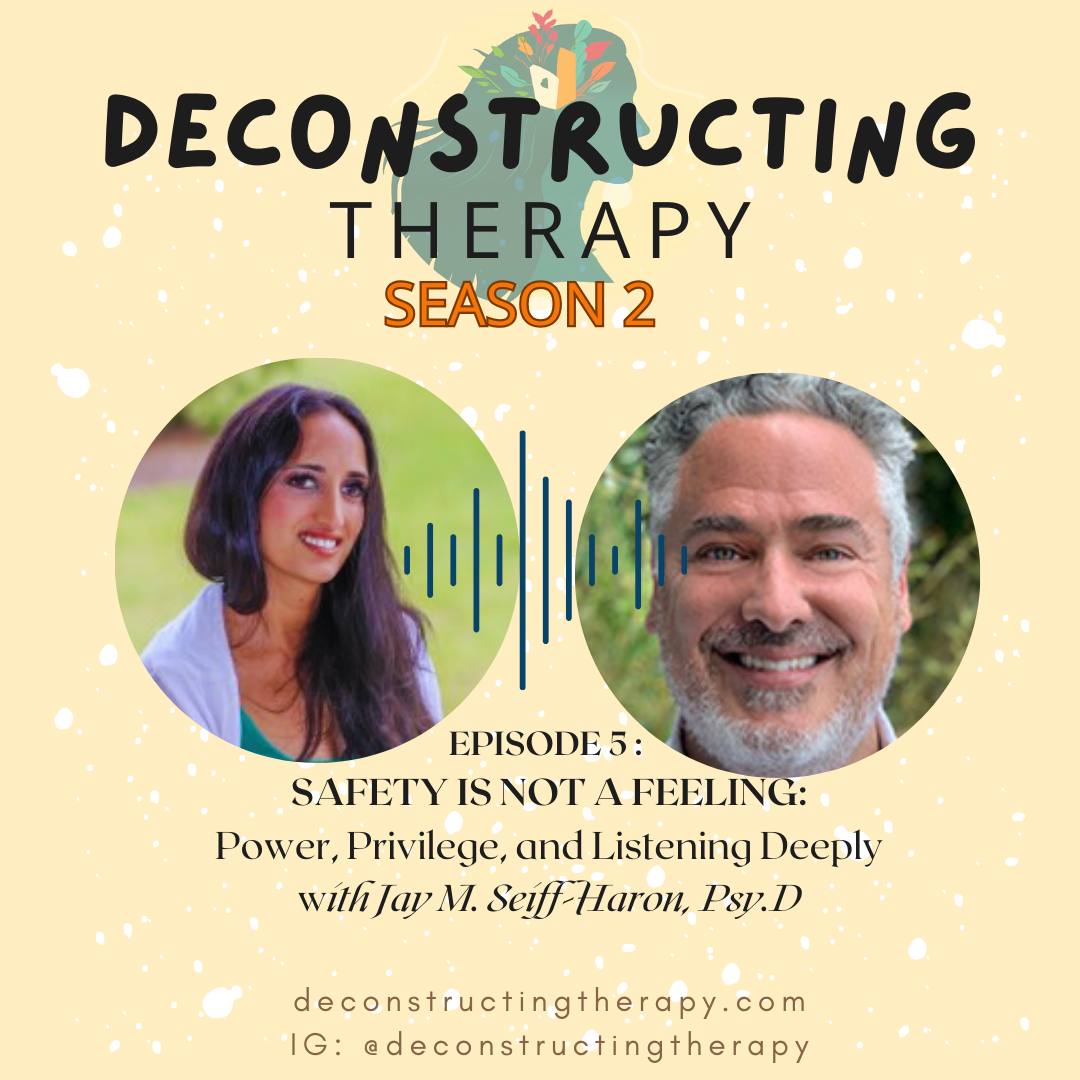
Jsef Haroun is a certified emotionally focused therapist and supervisor in training based in San Francisco. He specializes in lgbtq, BIPOC and interracial relationships, as well as working with preschooler parent dyads facing domestic violence, separation and trauma.
Jay has a strong social justice focus and is passionate about cross cultural dialogue. He is core faculty at Cross Cultural Communications where he leads anti racism and cross cultural training and serves on the diversity committee for the International center for Excellence in Emotionally Focused Therapy. I'm super excited to talk to you today. A big reason I started this podcast is to amplify voices and perspectives in therapy that are taking typically miss like understanding power dynamics and culture and oppression. And you do some wonderful, wonderful work in that area in the EFT community. You've done some beautiful trainings on liberation and power dynamics that have been inspiration to me. You have deepened my personal understanding of individuals that have kind of complex identities with very oppressed and very privileged parts within the same body. Yeah. I'd like to just get to know you on a personal level today first, if we could start off kind of what if you want to start off with your family dynamics, kind of how you grew up or just even what led you to wanting to go get into healing work. I guess if I could simplify the question, it's like, what, what has driven you to be a healer, to be in this work in the first place?
[00:02:43] Speaker A: Um, you know, I started out in corporate America and I always had the same reaction, which is what we were doing was, was interesting, but there was a certain level at which I just didn't care, like if we made our client more money. I sort of kept gravitating towards something that would help my colleagues or something that would be more human. So I eventually kind of drifted towards psychology because it just felt more meaningful to me. I was born in New York, so I'm a Jewish New Yorker, 100% Ashkenaz on every side. I grew up in the suburbs. I was the only one in my family who was gay. And. And part of my interest is in genealogy was. I would ask my parents, like, surely there was someone else, but that was part of the interest in genealogy at least. And then I think my count of queers in the family is now at something like 21. They're living queers and long dead queers. It was not as you sort of expect. Like, you know, queers were always there. So if you dig around, you start to find. But I think for me growing up, feeling like, well, for one thing, I was in the closet for a long time and I, I was sort of like self closeted. Like, I.
[00:03:54] Speaker B: So when you're saying self closeted, you're like, it wasn't. There wasn't a lot of external pressure to stay in the closet.
[00:03:59] Speaker A: There had been external pressures, but I think they were inadvertent, like comments that were made or things that I heard.
But I think it. I always kind of felt like I was like, like closeted. I always felt like I was trying to pass. And so I think that just gave a different flavor to things. My parents were visually identifiable as Jews when they were growing up and they experienced a lot more like external discrimination. And therefore they, like their way of finding safety was to sort of whiten us out as fast as possible. And I sometimes say, like, the whitest part of my family is that we were able to do that in a generation and a half. And so like, we were able to become white in that span of time, whereas there are black folks in this country who've been here for 400 years. And like, that transition still hasn't happened. That gave access to like the GI Bill. And other forms of developing middle class wealth that were closed to other populations.
[00:04:49] Speaker B: So your parents were.
Had to deal with difference a lot, but their experience of difference was definitely a lot more prominent.
[00:04:56] Speaker A: It was different in that day and age. And then, like, I think they worked pretty hard to like, make us white. I don't. I mean, I feel like they had this more indeterminate experience than I did. Where I grew up, the town was like, like heavily Jewish and Italian. And then like an increasing number of Korean and Chinese people were moving in over that 10 years. And so, like, the town had been shifting. Like where I grew up, it wasn't notable. Right. Like, there was Jews everywhere.
[00:05:21] Speaker B: Yeah. So your environment gave you some acceptance of who you are. There was a lot of representation of people. Like, but there was some mixed messages at home about we got to be careful with our identity or present more.
[00:05:33] Speaker A: It was. I think by the time I came around, even that was sort of just very obvious, like who was. Who was still religiously Jewish, but no one cared. I didn't encounter much stress about it. It was when I got to college and was in a much more diverse community that I encountered things I didn't necessarily know how to handle, but nothing awful. As I kind of hung out with more and more diverse people, I think it became more notable. And then my husband is Muslim. And it's just interesting. Like, it did not seem at all odd or problematic to us that, like, we were Jewish and Muslim. But then as we started becoming a couple, other people found that really notable. This was always a little bit amusing. I didn't really experience direct antisemitism much until I was much, much older. I didn't have any, like, police brutality aimed at me. I didn't have any overt discrimination. Although, interestingly, my. When I talked about this once, my parents were quite clear that they'd been redlined out of a series of houses they wanted to buy when they first were moving to Long Island. They couldn't go to the towns they wanted to go to because it was made clear that Jews aren't welcome. But I didn't have that experience. They did. I feel like I got off pretty easy. And therefore. And I guess what, I guess where this kind of comes is in the current environment since, like 2016 and especially since October 7th. I'm quite frustrated with other Jews who have this narrative that, like, nobody experiences the kind of discrimination we experience.
Hate is hate, you know, like, lots of people experience lots of things that we don't even experience. Like, and it's Just so obvious to me. This never held me back, right? Like, I don't think being Jewish was detrimental to my progress. It's the opposite. I'm like a white guy who could be mediocre and kind of make mistakes and keep going. And I have mixed feelings about that because it makes me feel like, what have I actually accomplished or what's just been handed to me because I look like this, right? But so then I. I now encounter tons, mostly online, tons of Jewish people who are, like, so blindered to, like, what's going on around them, and they're all upset that somebody said a thing that was anti Semitic. And I'm like, yeah, that's an anti Semitic thing. How is that hurting you? Which of your children got thrown out of college? Who. Who got shot?
Right? Who's starving?
[00:07:43] Speaker B: That's you being able to hold the nuance of this whole thing. And we've had a lot of conversations about this. You're like, I get. I don't understand when people have to put themselves in a complete box. If I'm just depressed and I have it the worst and they're not able to see.
[00:07:55] Speaker A: And it's like, again, not any compassion for people who. I mean, there's always somebody. No matter how disadvantaged or made marginal you are, there's always somebody who has it worse, right? Like, there's no bottom to, like, how badly humans can treat each other. So, like, there's always somebody.
[00:08:10] Speaker B: There's always somebody. And have compassion for your own suffering because of that?
[00:08:14] Speaker A: No, of course. Of course. Somebody Jewish was saying, oh, you know, the liberals taught us all in social work to have compassion for those who are marginal, but not compassion for ourselves. And I'm like, that's funny, because I was taught to check in around being Jewish and queer as a way to understand experiences that are neither of those. Like. Like, I was not taught to, like, not have compassion for myself. And I'm like, we were taught to check in with where we have felt oppressed if we have, as a woman, as a Jew, as a queer, and, like, to think about what that would be like and, you know, for people being vacating glass ceilings or being oppressed in other ways. And so it's just weird to me that people don't do that. And it kind of wraps around to what you said, which is. I think it's also really obvious to me that I'm super privileged as a loud, highly educated white man. Like, Jewish can go either way depending on where and where and how I am. I think it was Pretty privileged. Growing up on Long island, what you're.
[00:09:09] Speaker B: Able to do is like, it's just a presence of. Let me check in with this identity. How does it fit in this context? Is there a part that's being discriminated against? What parts of me are privileged and the parts that are me oppressed? How can I connect that and grow deeper compassion for other people who have even maybe more oppression than me?
[00:09:25] Speaker A: And the idea that it's different parts, like, you can be marginalized as a Jew if that's your experience, and still be white in the same way that you could be like, white in Puerto Rico and still be Puerto Rican, like that you're like, I don't under. It's. It's so baffling to me that people think you could be like, you're either privileged or not. And I'm like, that is just not the world we live in.
[00:09:44] Speaker B: So it seems like you were always kind of able to hold that nuance. Well, how do you make sense of people who are experiencing it the other way, where they either have to put themselves in this box or the other?
[00:09:53] Speaker A: I mean, I think I was oblivious. Like, yeah, I just wasn't used to it. And then, so I would say it went from a different kind of oblivion. But I never. I never felt privileged. At that point in time. I was definitely in the closet and sleeping with men and like, not telling anyone. So I still had my, like, privileged facade where I could play on being white and male, which now I would say it wasn't a facade. You were privileged. But I always had these underprivileged, you know, more marginal parts. And so I never understood when people sort of react from. From maybe a very similar place of obliviousness where they've had the privilege to never think about.
Still never makes sense to me that they see privileges like either or. And you're either white or you're. Or you're, you know, a person of color. And I mean. I mean, that's true, but if. If your skin looks like this, like you're. You're passing pretty well.
I don't know. I don't know what was true a thousand years ago, but you look white.
[00:10:46] Speaker B: Even me, I'm not passing, but I have a lot of privilege from being lighter skinned than some other people in my culture. Right. So it's different in different situations. Seems like you're always able to hold it.
[00:10:55] Speaker A: And I get really upset when people can't have compassion. Like, the whole idea of, like, I have parts that are really privileged and I have parts that maybe are less so. And obviously I work with that. And as I've gotten more skillful at that, there are times when I'll. I'll look very, very privileged because I'm doing that on purpose. Because why would I. Why would I lead with the stuff that would get me most rejected? But it's really difficult for me how the, the inability to kind of understand that we're all many things or that we're both privileged and not privileged. How that plays directly into these conversations I'm having where, like, I'll say, I or various other Jewish people I'm friends with will say, you know, I just don't want any children starving.
You know, Gaza has the highest rate of child amputees in modern warfare. That is not okay. And we're going to be living with that for the next 80 years. Right? Like. Like, it's just not okay. Like, it's, it's. We're. And we. We have something to do with that. I think for me, it's, you know, a lot of neurodivergent people are just as sensitive. And all the men in my family have adhd. And I, I didn't realize that I did too, until I was in my late 30s. But I clearly, as I get older and my brain gets more graded, the ADHD emerges more and more strongly. I think I just have some of that justice sensitivity.
[00:12:07] Speaker B: So can you explain that a little bit for people who don't understand that? And I'm like, nodding my head and I'm in activist spaces and everybody's neurospicy. Right. Like, I get that. Yeah. But can you go into detail?
[00:12:17] Speaker A: The definition of autism has, has expanded to include people who just have slightly different brains than what's called neurotypical. And I think of it more like, we all have different noses, we all have different earlobes, we all have different brains. The whole idea of talking about, I sometimes call it neurospicy and neuro vanilla is silly because vanilla is also a spice. Like, we're just all different, Right? And a lot of folks who are autistic or neurodivergent or neurospicy and ADHD is a form of neurodivergence, are also very sensitive to injustice. And I think I do have that part of me. So I feel like I have that reaction and I've had it not just to social justice issues, but, like, if somebody's getting picked on in a group, in a group of kids in high school or like in a therapy Group where I'm watching some group dynamic play out and. And I don't feel like I'm constituted to just not understand it. So it's been pretty helpful for this journey. Like, I married a person of color who's also indigenous where he's from, so he was a minority there. He has said many times he came to the US because in Singapore the stereotypes he would encounter is bad at math, not too bright, very friendly, and probably a drug addict. And here it's like he's Asian, so it's like you must be very smart and very hardworking and very diligent. So he likes the racism here better, you know, but like he. He wasn't majority there and he's of course got a whole bunch of different things here. So like living with my husband for 26 years, I can see my privilege because we don't get treated anything like the same when we walk around in the world.
[00:13:47] Speaker B: Yeah. So it's kind of your journey with being queer and the kind of the complexities of being Jewish and different messages you got at the helps you understand people who are voiceless and misunderstood. But then also I think the neurodivergence piece is really important. Right. Because that's the one that, like, I can zoom out of things. If something doesn't make sense, I'm not going to just say, oh, that's just the way it is and keep going. When you're diversion, it's like it bothers your soul.
[00:14:11] Speaker A: I think kind of I've absorbed some of his worldview in terms of how he feels things, and then he's kind of absorbed some of my sort of weirdly heady need to like, verbalize it and talk about it and understand it.
[00:14:25] Speaker B: That's probably helped you both. So. Yeah, So I guess it's improved your compassion understanding and then his ability to vocalize things. How has this played out for you in the therapy field? So was there a period of time where you were just kind of taking it in and the way you were taught and having to do it in a way that didn't make sense to you and then switch over? How did you kind of get into this work that you're doing now, these liberation trainings?
[00:14:46] Speaker A: I think it was the EFT journey that did that for me. So I was a business major, so when I came into my grad program, chose a psychology doctoral program rather than a therapist master's program because I thought I was way too crazy to be unleashed on the public in what I thought would be like too few Years. So I just went, I'll just go get a doctorate. It'll give me more time to, like, work on myself. I always felt a little bit like one down to, like, people who had been psych undergrads. And, like, I remember the first week of my program, like, there was jargon I didn't know that everybody was flinging around to show how smart they were. I was like, what is decompensation? Like, what is that? Oh, I see. Right. Like, so I always felt a little bit like one down. And so for a long time, I think I, in my program at least, I was just sort of absorbing what they're teaching me. And I was gravitating towards, like, multicultural psychology. Like, I was gravitating towards things that were not so bleached out, but I didn't understand how it would change the praxis of what we were doing. And then when I started learning eft, I was immediately like, oh, this is good. So I switched my husband and I into a couples therapy that was eft.
And then we were talking about, like, the time my white self gave him advice in tandem with his white therapist. And we, we pressured him to make a really dumb decision based on a bunch of white assumptions. We were always talking about things that were happening in couples therapy.
[00:16:06] Speaker B: So in your personal experience, it was always there. It was just this. I'm swimming in this reality.
[00:16:11] Speaker A: Like, we talk about all kinds of trauma in eft, and couples in many ways are looking for somebody to have each other's back. Which to my mind is not just about belonging and togetherness, but also, like, safety. Like, why would we not be talking about things like oppression that make people so unsafe, not just feel unsafe, but threatened of danger? And so it just didn't make any sense to me. And then I think. So that took me a while. I think it was as I started to learn more about EFT and compare it to what we were actually doing in our own EFT therapy that, like, the light bulb started to go on, that all these concepts we're learning are applicable. They're just not being taught. Like, they're just not giving any of these examples where this is made prominent. But it comes up all the time in our therapy. We're constantly talking about it.
[00:16:53] Speaker B: So how did you start shifting from that to, like, I'm going to teach this in another way. I'm actually going to help other people understand this.
[00:17:00] Speaker A: In, like, late 2003, I started doing this week long anti racism, anti oppression immersions. I didn't yet know how to call it liberation oriented. But I started doing these, these week long things where we take like 30, 40 people away to vacation homes and process the relationships and the privileges and lack thereof in the communities. And it was a really heartening experience. And it was all based on non psychological colleagues of mine who nevertheless were using a lot of gestalt to run these groups. They were all from a different, you know, an older generation. And then at some point I realized like I'm doing things in these groups that are all about like power and difference and connection and liberation.
And I don't know how to do that with like an individual client or a couple. Like I'm doing. It was like I had this one part of me working in this one way in groups and then a different part of me working with individuals and couples. And eventually it just became important to me. Probably around, I would say around 2009, 2010, as I was kind of about to get licensed, I started just needing to bring it together. I was part of a group that presented on EFT for same sex couples. I want to say it was 2007 or 2008 and then I did one on Cross Cultural Families in 2012. I think it didn't really take off till I met Nalani Collamer, which was 2020. She and I were just vibing on a very common way of seeing a lot of the things we're talking about. I think that she had a big influence on me. I think she was helping me realize, look, we could articulate this, we could verbalize this and we could teach this. And we both just had a very similar notion that there's nothing in EFT that isn't applicable to power and difference in culture. It's just being taught that way.
[00:18:37] Speaker B: No, I mean both of you have such a big important voice in the community. You know, I've talked to people outside after, after our training as well that I recently went to yours and they said, you know, it's changed so much for them in the way they're practicing. So it's, it's very, very needed. So I, I appreciate that. What I'm getting a lot from your story, even like deepening the understanding of that nuance. It's almost like that part of you that understood oppression really kept connecting with other people who are more oppressed than you and marginalized people. And then it's almost like that privileged part of you keeps adding a voice to it.
[00:19:09] Speaker A: I think that's right.
[00:19:10] Speaker B: It's kind of a cool mix to have both of Those parts, if you can understand and, like, utilize both of them, like, I can use this to tap into other people who are voiceless and maybe people who are just have more. Just oppressed parts. They don't have that other privileged part to speak up for them and be the ally for them. And it's like you kind of have both in one body, and it can be confusing.
[00:19:28] Speaker A: I remember at one point I was processing a lot of guilt with my own therapist, and I think there was a point where I was feeling guilty, but am I doing it for me, or am I doing it to help other people? And so there was this sort of privilege, I want to be the one to make sense of this, or I want. You know, it was very, like, narcissistic in a way. But I think it actually took me five more years to connect with. That wasn't coming from narcissism. That was because I felt unsafe. I feel like it took me a few more years to go, no, I'm not. I'm not involved in this to promote and toot my own horn and get rich. I'm involved in this because I don't feel safe when I don't understand why some people are getting listened to and some are not.
[00:20:03] Speaker B: I love that curiosity. It seems like you kind of just step into a lot of different situations and say, okay, where am I? What are the rules? What's coming from me? What's where? You keep that question and that curiosity open instead of getting swallowed full with either, no, I'm fully oppressed, or I'm just privileged or just not the black and white. I mean, that's such a great point, though. It's like when you can touch on something in yourself that resonates with somebody else, you can pull that out of them. And that's probably such a gift that you have during therapy. I just really, really appreciate the complexities you have with your own parts and the understanding and the curiosity and the way you're stepping into situations. If you were to give advice to somebody else who doesn't fully.
Doesn't have that ability to kind of be as curious about their different parts or see the nuance of it, how can they start doing that?
[00:20:48] Speaker A: Well, it's. It's tricky because when I feel pessimistic, I feel like. Like, I wouldn't have been motivated to do that if I didn't fall in love with my husband. And then, like, kind of see walking around how differently we get treated. For me, I want to connect a line from like, because I'm with my husband and I see what he goes through kind of affects, you know, like, my compassion. And you know, I get pessimistic. Like, maybe the only way to really, for people to really get it is to have it in the family and see it. You know, I don't have this ability to just sort of like, well, that's.
[00:21:18] Speaker B: Just the world part of the neurodivergence. And for you it's just become such a norm of like, no, this is how I see things. If it doesn't make sense or I'm going to fight for it.
[00:21:29] Speaker A: I would like to think that our, like, our colleagues care about their clients and they do have like, intimate knowledge of like their clients struggles. And there must be a way to help people, like, not only turn on their compassion where they feel for it, but actually not write that off to like, you're in your own way. Like, our field has always had this idea that it's a very colonial notion, right. Like, safety is just out there for you to feel it. And if you feel anxious, like, you should just sort of not feel.
[00:21:55] Speaker B: Do you feel like you have to connect to something within yourself in order to really connect to.
[00:21:59] Speaker A: I think so. But I'd like to think that our colleagues to connect with their caring for their clients and then catch themselves when they're thinking, oh, you know, this is just something that's in their head.
[00:22:09] Speaker B: So say somebody has had more of a prejudice life. They've had a lot of safety, and how can they in an embodied way to what it must be like for somebody who doesn't even have that safety. They've never had even gotten close to that experience.
[00:22:22] Speaker A: I think if you're really deeply listening to clients, you have to let them challenge your view of the world. Right? Like, if your view of the world is that safety is out there for everyone and we're all equal and people of color and queers are just putting barriers in their own way with very libertarian kind of idea.
It's very dismissive of what our clients are telling us about the world they live in.
And so I would think like, at least maybe we could be listening for like, our clients have many different feelings and we do need to help resource our clients to deal with the world the way it is. But is the only way to do that to dismiss their notion of being actually in danger and in threat? When we hear stories like somebody's child was shot and killed by the police, or, you know, their grandpa was just deported, but like, that's not a feeling and it's not something that as a white privileged therapist, you're likely to have to deal with at all. And we could let that in.
[00:23:17] Speaker B: Yeah.
[00:23:18] Speaker A: And so I feel like there's something.
[00:23:19] Speaker B: About listening inward and see how you can help them internally resource. It's like, can we really slow down? Especially if you've had a more privileged life of like, can I get closer to this experience? I'm never going to get fully there, but let me get closer to what their view of the world is first.
[00:23:36] Speaker A: Let it be a question that the world as I experience it as like a white man is just different than the world as you experience the same world as a woman of color. And like, to me, that goes without saying. That's just really obvious. But I don't think people realize they're holding these assumptions. Colonialism required people to like, check their compassion and not challenge, like obvious hypocrisy. Like, like, like we can convince ourselves that we're bringing Christ to the poor heathens all over the world.
And you have to just sort of not notice that most of them are dead. Like, they're not Christian. They're dead. There's a series of thought ways that we seem to have accreted over the last thousand years among white people that teach us to have these kinds of unquestioned beliefs and that I think we smack into them in therapy when we just think, oh, that's all in your head. Right. And so it's not like a coincidence. It's like we're still working on like, decolonizing that whiteness out of ourselves so that we could hopefully decolonize the world.
And then all of our theories of psychology for the. Until recently were developed by white people. So it's like this stuff isn't questioned. It's just like baked right in there.
Right. And so I just find I go back and forth between, like, we're going to do this better now. Now we're aware and we're talking about it and people are receptive, including some white people, but that doesn't matter. Like, there's also other people here now in the field. And then I go back to like, I don't know, it's been 900 years and the British are still using Jews to kill Muslims while killing more Jews. Like, I don't know.
[00:25:09] Speaker B: So you kind of teeter between the hopelessness and the hope back and forth. When you start seeing change and you see people waking up and then you're like, oh, shit, there's so many patterns that are still happening.
[00:25:19] Speaker A: Like our Field just encourage, you know, our, the sort of culture of white people, Europeans, like, it encourages us to not question exactly the kind of hypocrisy that then we use to hurt our clients. And I'm like, we have to question that. It doesn't make sense to me in terms of teaching it to people. There's like a white on white need to like work on some of these assumptions and what they're for. Because the part that's tricky is I don't, I don't want to hash on anyone's culture. Like, I don't care if you're Irish or German or French or British. Like, your culture is yours and it's what helps your ancestors. Right? Like, it's something I learned from Nalini that in a lot of ways coping is passed down to us by our ancestors who lived. And so there are all sorts of ways in which whatever we're doing, it's, it's a tool. Right? But I don't think we've really as whiteness, I don't think we have successfully yet grappled with some of those cultural tropes were designed to teach us to ignore suffering because they're not there to.
[00:26:16] Speaker B: Cope, they're there to more dominate.
[00:26:18] Speaker A: But you know what I mean? So it's not just white people who do it. It's power does it, it's privilege does it the whole world over. I just feel like it's a really big question, like how does one help people start to even have enough distance from that to be skeptical of what was this for?
Because a lot of the parts about overlooking hypocrisy was about letting the rich stay rich while the poor continued suffering.
[00:26:42] Speaker B: But I like your kind of shifting to the question. It's not just about your whiteness. It's like, can we just look at it from a place of power? How is this power serving you? How is that power played out in your history or your ancestors? And how is that still playing in you today?
And just maybe getting curious about your own history around curious.
[00:26:59] Speaker A: I'm like, do you like what that was for?
When I started doing these anti racism workshops with my dear friend, I kind of thought of him as an adopted grandpa. His name was Freeman. He's gone now. But Freeman was an African American man from Tennessee and he'd been doing anti racism work forever and ever and ever and ever. And he said, oh, you know, back in the hood, we don't, when we see mental illness or anybody being crazy, we just walk the other way. It's Like, I got enough problems of my own. And so we used to have arguments because sometimes stuff would come up in these groups we were running, and I'd be like, we need to help that person. And he would be like, why?
You know, like, he just wasn't that sympathetic to it.
That's also how people look the other way in any kind of suffering. Right. We can all look the other way.
[00:27:41] Speaker B: And how does that benefit you? And how does it. What does it cost you? Right.
[00:27:45] Speaker A: And it may benefit me. If I have enough problems of my own and I'm up to here, then I don't have my energies further attenuated. But that's not something I want to do long term where I just turn. Turn my eye to suffering.
I really like the decolonizing movement that I know you're part of. And I also like Tama Okun's work around helping people define whiteness so that it can be looked at with some working distance.
I think the website is called white supremacy culture. Whitesupremacyculture.info, something like that.
[00:28:16] Speaker B: Would you say that's a good place for someone to start who's just starting this work or trying to understand their power? Okay, so if you were to take everything that you're talking about today and say there's somebody who is just starting to understand this stuff or understand the complexities of their own identity, and maybe somebody who's got more of a mixed identity the way you do, like, where would, what advice could you give them to start? Or what can they start asking themselves? Maybe how can they start the curiosity process?
[00:28:42] Speaker A: Nobody really wants to start with where they're privileged and could be more accountable for sharing that privilege. Right? That's what, to me, that's what one does with privilege. If you have privileges, you should share that with people more marginal than you. That would be so much better than hoarding it, for example. And so it's interesting that even the most privileged people would come in and want to tell you about all the problems they've had and how their life hasn't been easy. Then there are folks who, I think, just have no experience with oppression. They confuse, like, momentary inconvenience with oppression. And that's not the same thing. Not having oppression in your life wouldn't mean you have no problems. It just means the problems are less often fatal. There's a larger safety net. Doesn't mean you don't have problems. And so I think there's something about just an orientation towards oppression and like, what it is and how it's affected you. And if it's affected you by you, learn to close your eyes to it. Let's open them. But I think most, most, I mean, in a field that's woman dominated, I can't imagine we have any colleagues who haven't dealt with sexism, you know, like misogyny and misogynoir out there everywhere. Misogynoir being that intersection of sexism and racism. It has its own sort of interesting look to it.
[00:29:47] Speaker B: You're saying, let's start the conversation with where are we privileged?
[00:29:50] Speaker A: Can you get empathetic too? Since we all like to sort of grab like our own story and pick it up where we were oppressed or where we think we were oppressed. Start with that and think about how impactful that was on you and everything you've done around that. And now let's look at folks who have to worry that when they walk out the door in the morning, they'll be murdered for being trans or that their kids will be shot by a police officer for being in the wrong place at the wrong time. Right. And like, help people get in touch with what they're not dealing with in some ways, but. But from a place of compassion for what it's like to be oppressed.
[00:30:20] Speaker B: I really appreciate you and the work that you do in this community. It's really, really impactful.
How can people find you? What is, you know, if they want to learn more or do more? Can you kind of give me some resources for yourself and any other kind of resources that you would that people can start doing more of this work?
[00:30:37] Speaker A: Naomi Kalamor and I do some trainings together for mostly so far for therapists and people in allied fields like education. But I think we're available.
We've also done some facilitated meetings to help communities of folks work through some more meeting of minds. We do things like that too. But that website is eft Lifeline.
Com for emotionally focused therapy. Lifeline. Com but just anything that helps people to sort of hold each other with compassion is, I think, what we're about. And that's compassion for being castigated as privileged as much as it's compassion for being sort of actually stymied or stopped in your life for being made marginal. We want to help humans to hold each other as humans.
[00:31:21] Speaker B: Beautifully said. Thank you so much for being here today and sharing your story.
[00:31:26] Speaker A: Can I. Can I add one more thing, Olivia?
[00:31:28] Speaker B: Sure.
[00:31:28] Speaker A: As a Jewish person doing a training where I'm mentioning October 7th, I always want to say, regardless of one's political beliefs about who's at fault or what caused it or any of that stuff.
Starving children is something I believe very deeply in. James Baldwin's comment, like, the children are all of ours all over the world. And that if anyone who doesn't understand that may be incapable of morality. Like, I don't think starving children is okay anywhere. So every time I mention any of this, I give a donation to the Palestinian Children's Relief Fund, pcrf.
[00:32:00] Speaker B: Thank you so much for mentioning that. And this is just such a heavy time. It's been a heavy time for the last last two years, but especially now as things have gotten to the level that they've gotten and I'm a Muslim woman, you're a Jewish male, we're doing this work together. A lot of the world wants us to believe that we're enemies, but I think you and me, you know, we don't agree on everything. But we both very strongly believe that what's happening right now, when you look at those children, that this is just, it is a question of morality.
[00:32:31] Speaker A: Like I just feel like Muslims and Jews are cousins, Palestinians and Israelis are cousins.
[00:32:36] Speaker B: There's so many similarities. Yeah. Like the things that kind of the stereotypes and stuff that you see and how people want to paint those two as enemies can be so self serving to people in power, but the reality of it is very different. So. But thank you so much. Thank you for your time today. Thank you for all the work you.
[00:32:51] Speaker A: Do and thank you, Alifia, for giving us the platform.
[00:32:55] Speaker B: Join the movement and keep the conversation
[email protected] and follow us on Instagram, Facebook and TikTokstructingtherapy. If you found value in today's episode, please subscribe and rate us on Spotify and Apple Podcasts. If you are able to and would like to help sustain the podcast, you can find us at buymeacoffee.com deconstructingtherapy to show your support.
Thank you for listening.