Episode Transcript
[00:00:00] Speaker A: I'm very curious in regards to what is it that you're hoping that you either explore or integrate? And I tend to use that language. So people ask me, what do you mean explore, integrate? Like, what is it that you're curious about? If you know that this is impacting you? And most people come and tell me I have anxiety, depression, anger. And I was like, if you know that this is, this label is impacting you, what is it that you want to understand about it? How are we going to explore? Do you have an idea? Because most of us when we go to therapy, we have a fantasy. If I go here, if I problem solve this, I'll be fixed, everything will be fine.
[00:00:35] Speaker B: Welcome back to Deconstructing Therapy. If you're here, maybe your spirit, like mine, knows Western therapy isn't the whole story and that the intensity of these times is revealing both our wounds and our power. Together we'll listen to powerful storytellers, therapists, teachers, activists, humans who carry both brokenness and brilliance. Their voices challenge the limits of Western model and open us to deeper ways of healing rooted in culture, justice and liberation. I invite us to lean in, let our spirits fully arrive and allow this to be a pause in our day. Together, we'll reimagine what therapy can become when it truly belongs to all of us.
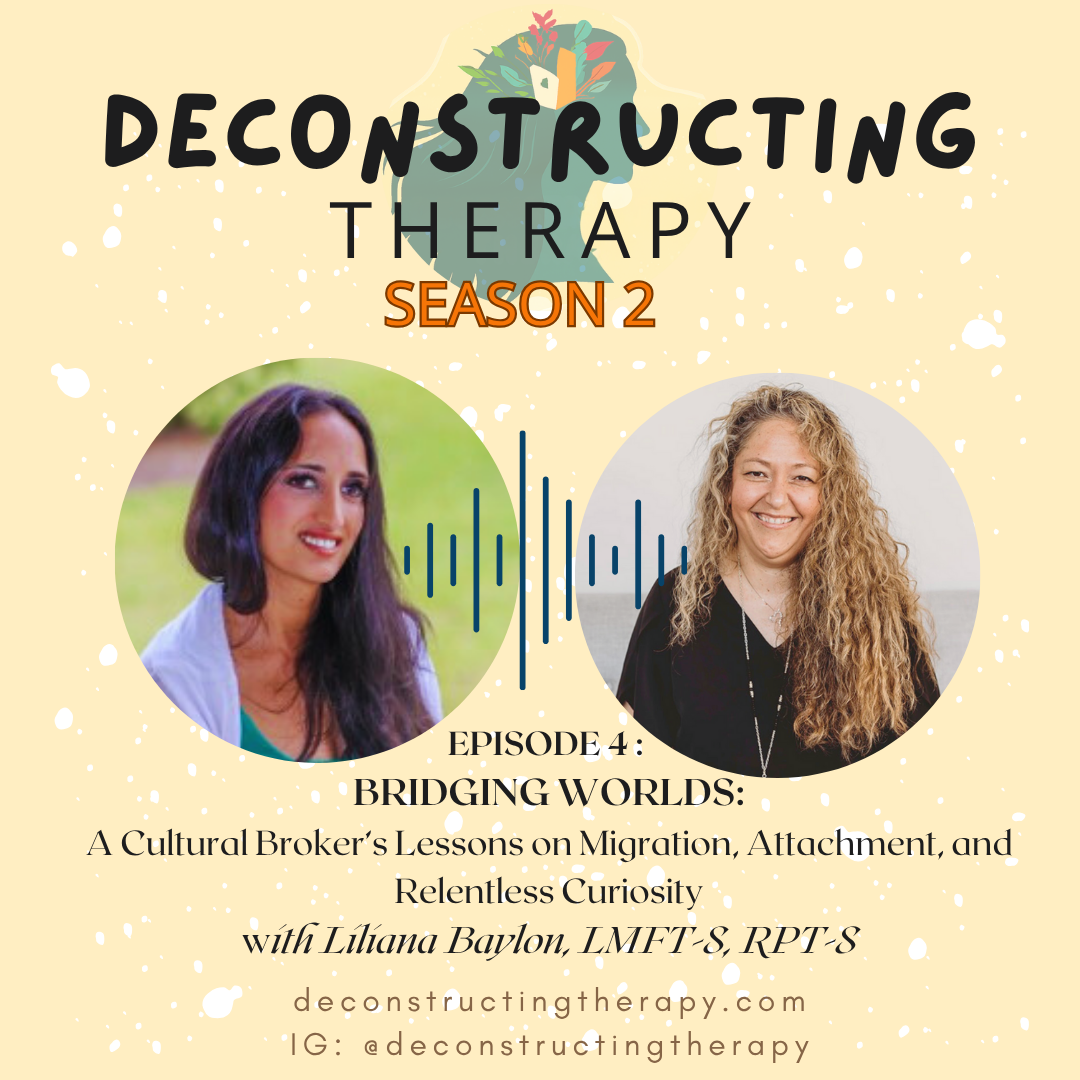
Liliana Bailon is a bicultural bilingual psychotherapist, international speaker trainer, author and consultant with over a decade of experience in trauma and multicultural issues, particularly among immigrant and refugee populations. Or her work centers on cultural humility and the psychology of global migration. As a thought leader and advocate for inclusivity, Liliana provides training, supervision and workshops that help professionals and organizations create trauma, informed, culturally responsive spaces and foster deeper cross cultural connection.
Yeah, you're somebody who I've kind of seen and been on my radar for a while and heard wonderful, wonderful things about you. So I am very excited to hear your story today.
[00:01:54] Speaker A: Thank you.
[00:01:55] Speaker B: So I've seen a lot of your stuff professionally, but today I wanted to understand a little bit about your background. What got you into this work? What made you decide to be a healer, get into therapy?
[00:02:06] Speaker A: Well, thank you for inviting me and thank you. It's an honor being watched.
So I actually started, this is my second career. I have a whole background before becoming a mental health therapist. But I will say in regards to therapy, I was always looking for something, but I didn't have it, was not organized in order for me to know what. And I guess now I can say having a parallel process with my family. So Watching my family navigate, coming into a new country, learning a new language most of the time, and then understanding firsthand the impact of migration and mental health, that's what actually drove me into this.
[00:02:49] Speaker B: What was your profession before?
[00:02:51] Speaker A: I have an mba, I used to help businesses develop any of the plans that they needed to be or organize for their purpose. It was a big time switch.
It went from I was doing that I needed to do something else in order to give back to the community. So I started doing mediation.
[00:03:10] Speaker B: What drove you to say, I need to do something else? This is not. There's something missing.
[00:03:16] Speaker A: There was no human connection. It was always like writing and planning. But even though I was working with mission statements, I was always working. There was something missing, which then I started. I heard that my county needed mediators, bilingual mediators. So because I'm an overachiever, I went and I went to Colorado State University and I started they have a mediation program. So I took one class and one class was not enough.
So I took additional classes and I become a mediator specialist. So when I was volunteering during that time, I noticed that people keep coming back. It was because the court system is very factual. It's not. There's not attending to emotion, which led me to do research. And I discovered that there's actually a whole career about it.
So then I went back to get a second master's degree. So first master's was my master's in business administration. Then I got a advanced certification on mediation. Then I went and started a master's degree on counseling because none of my courses and my MBA work for master's in psychology.
[00:04:30] Speaker B: But you had the intention to use the counseling to do mediation still, I wasn't clear.
[00:04:35] Speaker A: I knew that people were coming back, so I knew that I could have clients in mediation because most of the, by the way, the county became aware of me because I was bilingual, I was female. So most of the mediation that I was doing was parental agreements.
So little by little, I started noticing that there was. There was a need and there was a niche that there was not being attended to. So that's what led me into this. While I was in my master's program, I knew I wanted to work with children. Not couples, not families, children.
So while I was doing my master's during the week, during the weekend, I was going to take classes to become a registered play therapist.
[00:05:21] Speaker B: And this is something you've always had a heart for. Kids.
[00:05:24] Speaker A: I just knew that kids, that's what I wanted to go. And I think it was because of the parental agreements.
Most of the time that I work with adults, I saw that the children were not being attended to. It was more about the adult's view. And even though the focus was always the children, there was nothing about the children on those meetings.
[00:05:45] Speaker B: You wanted to give them a voice.
[00:05:48] Speaker A: Yeah, but once I was in my program of I'm a marriage and family therapist. Once I was in my program, I started organizing the parallel process that I was having with my family in regards to we migrated. My mom was a single mom, migrated from Mexico. And at that time it was just push through, learn the language so that you can help us. I was the oldest, I'm still the oldest, Help me translate, help me make appointments, like, help me. So it was always that push through, but not understanding of what we were going through. And the masters in counseling started organizing like, wait, there is actually a trauma here that I have not been able to make sense. Wait, I was carrying my mom's and my siblings trauma because I was like taking from them in order to help them navigate this.
And then I knew that I was bilingual, but I did not understand actually the idea of growing up in two worlds and how each one was demanding that I show up differently. And each one questioned me, do you belong here? Which it was hard. And then in that process, as I share, because I'm an overachiever and I think part of it is being a migrant, part of it is taking the role of cultural broker and helping my family with everything that they needed. So as cultural brokers, when we are the oldest, when our families migrated, a cultural broker is someone who takes on the role, almost a parentify role, but is always helping, especially the elderly, in this case, parents, caretakers with translations from doctor's appointments to government appointments, to schools.
I was thinking even an example, a time that I went with my mom to have a colonoscopy. And my mom gets really nervous, even though she understands English, my mom gets really nervous. So they asked me to go in, into the procedure to explain to my mom what they were going to do, ask my mom. And she has questions so that I can ask the professionals there. And I was like, I did not went to medical school to understand this. But that's exactly what cultural brokers do. We tend to go and overcompensate and hope for the best, that what we're translating gets across the two worlds that we're translating. So we are bridges for our families, making sense of the world, of the policies, of the language, of everything in between.
[00:08:24] Speaker B: And think about the Weight for that, for a child. Yeah. And then when you're talking about, then you're taking it on from siblings to yeah, no. And it's heavy.
[00:08:33] Speaker A: It is, Right. So at that moment I couldn't understand everything that I was doing. It was again, not until, until later that I was like, wait a minute. I went through this and there was no vocabulary. And the adults around me, they were not curious, not the teachers, not, not everyone, anyone across, because they said, as this is what you do in order to succeed, you help the family, you push through, you are successful. But there was no in, how's your mental health? There was no how are you doing breaking cycles. Because they romanticized it as like, look at you, you are doing all of this. But there was no understanding that that was becoming heavier and heavier. Because for my family, in one hand they were really proud and the other hand they were like, do you belong? How do we talk to you? There was no understanding of you're still one of us because you talk differently, you seek different things, that they're beyond our comprehension.
[00:09:35] Speaker B: So the exact thing that you are doing to actually bridge all the gaps and assist everybody is also causing you to have less belonging.
[00:09:43] Speaker A: That's exactly it.
[00:09:44] Speaker B: Right.
[00:09:45] Speaker A: So I think at this point, and part of the work that you are seeing is that I'm trying to rediscover not only my roots, my traditions, my language, but also be a template, not a. It is like a template that I'm creating so that I can help everyone else understand and be curious about stories.
[00:10:08] Speaker B: Right.
[00:10:08] Speaker A: It's not just the resilience which everyone seems to really, really love when they listen to my story, but it's not the layers of my story that come with all these mixed layers of success and heaviness.
[00:10:23] Speaker B: Yeah. And you're right when you say that either the focus is too much on the resilience or too much on the trauma. I feel like in this very pathological, two dimensional way.
[00:10:31] Speaker A: Yes.
[00:10:33] Speaker B: And you might have a parentified wound. Right. Like so many kids we see with that. But it is a different thing when it is from migration.
[00:10:42] Speaker A: That's exactly it. So I think once I graduated, not became, because I feel that we never arrive, even though we have the systems that say you arrive when.
But once I graduated and being an overachiever, so then, yes, I became a registered play therapist supervisor. Then I pursue eft, I pursue emdr. I was always looking for how can I help people like me. That we do not benefit just from one tool because our life is not linear. It's complicated.
[00:11:14] Speaker B: So what made you go from, hey, the play therapy is not it. I need something more.
[00:11:20] Speaker A: So I started working with kids and realized, oh, I cannot just focus on the kiddo. I need to work with the whole system. Because if I work with the kiddo, I'm. I'm setting the kid to fail because I'm giving them language and then they go back. But the system is not working. It's. I'm sorry, it's not changing. So actually, it's the whole system that needs to have be empowered. And when I say empower is how can you see what's working, not working, how can you see the difference versus always looking for the same?
[00:11:53] Speaker B: So you kind of kept hitting these roadblocks. It's interesting how first you were just working with the parents. You're like, no, no, no, the kids don't have a voice. Let me go on the other side. And then you're like, nope, nope, it's the whole story. I have to do something else. So then you went into family therapy. Is that you did?
[00:12:05] Speaker A: So then I started focusing on working with the whole family. It's so weird because that's why my colleagues are like, wait, what? Help me understand who you are. So I started with kids, then I went to the family. As I'm working with the family, I realized, man, let's work with the couple.
The couple is struggling here because now we are marrying either when they're both from the same culture and they came from, let's say, anyone in Latin America. Let's choose Mexico, for example.
So they come in, they adapt survival strategies from going to work learning the language. So usually what you see is that one person will assimilate faster and the other one doesn't.
So then they start being discords because one is changing too fast, the other one is trying to hold into the roots.
So then I was like, okay, let me go here, because I'm noticing now this need here, which when you zoom out, you start seeing. I'm still actually working with the whole system. It doesn't mean that I stop working with one. I still work with children. I still work with couples. I still work with the family. But because of all those trainings, what I realized is that I can zoom in and zoom out depending on who. What needs me in the system. I have to justify it in my notes.
That's the tricky part of why am I zooming in and zooming out? But that's actually how it evolved in me helping individuals, couples, and families and then moving into, let Me share with others, with other therapists, what I have learned in this journey. When you're working with now, we can say newcomers, migrants and first generation, because it's not this umbrella of either trauma or bipack or migration, which in migration, people tend to think like, well, you migrated, you made it like, everything is fine.
It's never that simple. It has been an ongoing, even learning for myself, because there's no training for us in regards to how do we work specifically with this population.
Think about a puzzle, like pieces together, trying to make sense. I don't even know if this puzzle ever is going to be completed, maybe after the new cohort of therapists. But what I do know is that I am seeking, from what I'm reading, the trainings that I'm taking, the people that I'm following in regards to, what is it that I don't know? What is it that I can do better?
Because we still have gaps in our field, and I'm talking about psychotherapy, we have so many gaps because there's no understanding of how to work with this population.
[00:14:55] Speaker B: No, that's so true. Can you speak to some of the gaps that you're noticing?
[00:14:58] Speaker A: So, for example, I noticed that either we focus on language, per se. So, oh, you speak Spanish? Go here. Well, yeah, you can speak Spanish, but you have a lot of nuances, a lot of. If they come from different countries.
So then language was not enough. Because then you can get in trouble for not knowing or for not understanding. Especially when you zoom out and you say, all Latinos or Latinx or Latines think like this.
These are important to them.
When in reality, most of us have different values when it comes to. So then I noticed part of the gap is not just language. There's not a lot of us, first of all, who speak Spanish and can hold sessions in Spanish. Then you take it into the gap of being bicultural.
Not everyone actually is truly bicultural. You don't have to be.
But then when you say, I can work with this population, do you understand the values? And how do you have that? Do you have a shared experience? Are you going abroad? Are you gaining that from the agency where you're working with this population? How can you say, I understand this bicultural piece?
So language being bicultural. And then even if you have that, I always talk in my trainings like, okay, so I migrated when I was 16.
You can say, I'm bicultural. I have to keep going back. I take trainings from Mexico in order for me to understand language, in order for me to understand dialogue? What are the vocabulary that you're using? What are the issues that you're dealing with? How different is what you're dealing over there than when you come over here? So is this constant seeking for what wa can I see? And I miss if I'm not taking or being aware or being exposed by others.
And the EFT community, there is actually a group that brings all these different countries that we share, in this case, language, and then we learn from each other. So then I started joining that group and I'm like, tell me from people. Like, I want to learn from people from Argentina. I want to learn from what? Like, tell me all these places and how can I learn? Right. Which as a therapist can be exhausting because then you have to go to all these groups in order for you just to be competent enough, and it's.
[00:17:29] Speaker B: Impossible to learn all of it. And then even when you do, the person sitting across from you is still going to be different within their own context.
[00:17:35] Speaker A: Right, so exactly it.
[00:17:38] Speaker B: Right.
[00:17:38] Speaker A: So. But the idea is, can we start by being curious?
So anytime that I sit with someone and they tell me I'm from Mexico, or the other one may say I'm from Argentina, I was like, great. What is one thing that I need to know about your upbringing that you may not know that is impacting you today? Right. So, like, is this curiosity of tell me more about you. Tell me. I notice when I make mistakes in languages because they do the smile. Because I've been in this country for over 30 years, so a lot of times when I make mistakes, they. They do like the rolling of the eyes or like, oh, my God. And I was, like, I said it wrong, Right?
Can you tell me?
So then they will tell me and then like, we will use it. But, you know, I tend to bring humor into my work in regards to I will make mistakes not with the intent of, but if I do, would you give me the opportunity to learn and then hopefully to repair? And if so, what can I learn more about you so that I can do. I can be better for them?
[00:18:42] Speaker B: So it's just this relentless curiosity you're having everywhere you go. What did you learn about yourself through this process? Because often when we're in our own shoes, we don't realize the impact or the changes or what. It's just so normalized. So when did you first learn? Oh, you know what? This migration really impacted me in this deep way because you were just living it. When did that first occur to you?
[00:19:05] Speaker A: I think the first time that I thought I did something wrong or I got it wrong was actually when I took. It was 20, 17, 15, 17, when I took my first EFT training, which it led me to.
My family did attach me wrong. So then I had to ask questions. I remember every day, any of you who have taken this training, you know that the first training is four to five days. So mine was five days.
And I will call every day my husband after the training, crying on my way back and like trying to sort out everything that we did wrong. Thank God for my husband.
He will be like just listening and. But that at that moment I started organizing a lot of like, wait, is this, at that time I thought we did it wrong. Then it went into anger in regards to that we did it wrong or am I being projected because of what my family is supposed to be? And then it went into curiosity because then I started thinking, trying to humanize my mom. How did my mom share with me her attachment lens? Like what are the things that she did that it was not through this lens that I'm being programmed to see through? So I think it was actually around that time that I started seeing not only in mental health, the projections that we do through the Western world, but then it led me to become very, very curious about my culture, our ways the ancestors did healing and can you.
[00:20:39] Speaker B: Give, can you give me more descriptions for that? So even, you know, the first instinct is, oh, we did this wrong and kind of like a pushback towards your parents, right?
[00:20:48] Speaker A: Oh yeah, I was angry.
[00:20:50] Speaker B: And again, this is just a very normative of what we see with migrants when we're going to Western therapy. And it tends to be like this disconnect when you're hearing that. So can you expand on that when you say wrong, like, oh, you were doing this wrong. What was the anger about? What was, what came up, I think.
[00:21:06] Speaker A: For me specifically was my mom didn't. My mom didn't love me. My mom didn't love me because she was not there cooking. She was not there telling me that she loved me.
She wasn't there comforting me the way that they're telling me that she should have been available for me.
[00:21:25] Speaker B: Yes. So everything that they prescribe of, like how your needs are met from your primary attachment figure has a western lens. Right. And it's all very verbal because, yes, this culture is very, very verbal. So when we have all the non verbal cues, we think we got missed.
[00:21:41] Speaker A: Yes, that's exactly it.
[00:21:43] Speaker B: And so I, and I'm glad you're speaking to this because it is, I know that's going to resonate with a lot of other folks too.
[00:21:48] Speaker A: And by the way, I do want to give prompts to my trainer because I will be asking him so many questions and he did the best that he could at that time. Right. So then it took me time to go back and then I went to the second part of that training and then I will stay and ask him more questions. So this, this is me, my true me in regards to. I'm curious, but then I'm. I'm pushing for what am I missing?
What can I learn? Not only him having the patience to stay with me, trying to organize it and try to make sense of it, but also it was coming home and having my secure attachment, in this case with my husband, and then us having conversations at how did our parents show up for us? And so he will tell me and then I will share with him. And then he started down on me like, oh, my mom made sure that I had a roof.
My mom will make sure that there was food and she will tell me that time. Any of you who are migrants, tell me how many times you heard, like, I have to go to work so that you can have a roof over your head or did you have food? And we'd be like, yes, but.
[00:23:02] Speaker B: But.
[00:23:03] Speaker A: And again, at that time, I couldn't understand that.
And it was not until then my husband and I developed this not only huge gratitude because our parents, and it's easy to say, did the best that they could with what they have, but you take it a layer further, which is they came in having this idea of parenting and then throw and then learn to survive.
And they actually did not have the luxury to go to therapy, to go to these trainings in order to make sense of their own trauma, what they went through, and so on and so forth. So now we're talking about this generational trauma, right?
[00:23:46] Speaker B: And it's like what you're talking about with the push through. We're just pushing through and pushing through and.
[00:23:49] Speaker A: Yeah, that's exactly it.
[00:23:51] Speaker B: Yeah.
[00:23:51] Speaker A: Anyways, I started organizing a lot of these things through that and then through the EFT lens. And then after that, I just didn't stop asking questions. And then this pushback of why does it have to be this way?
[00:24:05] Speaker B: What do you mean by this way?
[00:24:07] Speaker A: Like attachment. Let's use attachment language.
Why does it have to sound like this? Can we be curious about what attachment look like in someone's culture? Is it through rituals? Is it through sharing a meal? Is it through, like, I started discovering how my grandma I'm going to use my grandma. Before I went to school in Mexico, my grandma had a garden. Too many fruit trees, by the way.
You may fantasize it, but my summer really was I had to climb the trees and I have to pick up the fruit and then bring it down. But every morning before I went to school, she will start with the ritual of coughing, going and feeding her birds, and then watering the trees. So I started my mornings before I went to school actually lying down on the floor, looking up at the trees so I can see the sun coming through the trees.
And I was just listening to my grandma. Now we can say, Liliana, you were working on grounding before you went to school.
And I will tell you now, yes.
That I knew that back then.
No. That my grandma had the language in regards to attachment and grounding. No.
It was not until later, because I became very curious about what do cultures do in order to attach to each other, in order to ground to each other, that I started to become aware that it's not through what the Western lens has told us that that's how we do it, is that reality is that every language has something completely different.
Not every language, I'm sorry, every ethnicity has something different.
[00:25:49] Speaker B: So how do you assess for this? Because so much of the way we're taught to even assess is through language and through the language from the Western lens. And then we might miss something and pathologize things because we're missing a whole.
[00:26:02] Speaker A: Other context, honestly, curiosity. So I understand that all of us respond to systems. So if you are in private practice, you have the luxury of, if you don't work with insurances or Medicaid to take your time to get to know someone and be so curious and then take it as you go. But when you work in agencies or even in private practice that relies on insurances and Medicaid, you have limited ability at the beginning because you have to pathologize in order to set up paperwork, in order for you to get paid. So I'm very aware of that. Okay. But now what I can say is that I'm very curious in regards to not only asking the questions that we usually ask, which is what brought you here? What is it that you're hoping that you either explore or integrate? And I tend to use that language. So people ask me, what do you mean explore, integrate? Like, what is it that you're curious about if you know that this is impacting you? And most people come and tell me, I have anxiety, depression, anger. And I was like, if you know that this is, this label is impacting you. Depression, anxiety. What is it that you want to understand about it? Right? Like, how do you, how do, how are we going to explore? Do you have an idea? Because most of us, when we go to therapy, we have a fantasy.
If I go here, if I problem solve this, I'll be fixed, everything will be fine. So then now with my clients, I tend to have conversations of, there's nothing wrong with you. You develop survival strategies.
And in that your nervous system said, this is what we can do to survive this. And then we adapted because the brain is so brilliant in regards to, I know what to do here.
So then it keeps going back to these survival strategies that you adapted. And if you're noticing that that's no longer working, you need something else. It's almost like we're leveling up. If you play games, we go to the next level, and that's why you're here. And in. That requires me to understand a little bit about your upbringing. What are the patterns that you consciously or consciously got adopted and are repeating? And then can we just sort it out? It's almost like a cleaning. We're going and doing a spring cleaning just so that we can we figure out what works, what doesn't, what's yours, what you adapted, what you want to keep, and what you want to let go. It's not get rid of, it's let go. And then I explain, even when you let it go, it may be a time where you are going through something that you say, I remember, and then you bring it back.
But now the work will be, can you consciously bring it back? And then when it's not working, what do you want to do in order to put it away again? Yeah. So I think it's that language which now clients, when they come to me is more of, can you help me explore this?
And that's the language that they're using.
[00:29:00] Speaker B: And it puts it into a more of a curiosity place, non judgmental place. Just that word of where. Oh, we're just exploring this and says assessing it, figuring it out. Yeah, no, that's great. Even just your pacing, even as you're talking right now, just seems very slow and curious. And I can see if you just maintain that it opens people up and kind of creating a picture when they're talking, instead of just trying to get the small moments or the words, it's like, yeah, yeah, just like you did with your grandmother. Like, give me the whole piece. What were you doing? How was your body? Were you like? Yeah.
[00:29:30] Speaker A: So, yeah. So that's what I tend to do with clients now.
Um, but I continue doing that with myself because every time that I go to a training, now I have to remind myself this is a possibility.
What will be adaptations that I have to do because of what I know to be true for me and adaptations that I may have to the clients with the patterns that I've been seeing.
So now when I go to trainings, my brain now is programmed to look for alternatives.
How will this work? So it's not just go and, like, take in information like the Matrix, like, I'm just gonna take it all in now. It's more of like, well, that's a possibility. Let's write it down. What would be other possibilities?
So my brain is constantly either seeking data or being curious, however you want to put it on.
[00:30:20] Speaker B: Yeah. The words I'm just taking back from you is just relentless. Relentless curiosity.
[00:30:25] Speaker A: I have always been curious. I was sharing with my family recently, which is in Mexico, we say Preguntona. So it's like, you're always asking questions. Why can't you just be satisfied? And now my husband and I keep laughing because now we know that since I was born, I was always seeking information.
My family settled on surviving skills, so they learned not to ask because it was sensate. But I'm the generation that came in and said, well, let me try it. What's the worst that could happen?
So then I keep asking questions.
[00:31:02] Speaker B: So a question that comes up for me that I've been exploring more as well, is just, you know, from a lot of the traditional Western lenses, like, okay, what did your parents do to you? What is wrong here? How did they mess up? And it does make us angry, no matter what the culture.
I think with migrants, it's a whole other level because the systemic problems are such a bigger cause of it. So then even the pathologizing and blaming the parents can get heavier. How do you combat that to make it more nuanced? It's like, we can understand my trauma, like, even in your own story, right? You can understand how you're parentified. How do you do that without the anger towards your parents?
[00:31:39] Speaker A: That is, to my own therapist, honestly, she was my third therapist, because as therapist, it's not that I'm shopping for therapists, but I'm like, thank you for what you did. I have to go to the next level.
So I keep doing that. And so these therapists, she just helped me humanize my mom.
So she knew I was a therapist because I disclosed that now, I was like, now when I go to therapy, I said, I'm a therapist, I know how to answer. So I need you to challenge me. Are you up for the challenge?
So my therapist, I said, I need you to help me because there's so much. And we can say it's anger, we can label it that way, but there's so much grief, there's so much unanswered questions.
I think the goal, and she said it is to humanize your mom. And I was like, yeah, I'm not paying you for that, but yes, can you help me with this piece?
So it was thanks to her, her that she helped me organize, organize, organize, in order for me to see my mom as the human who was having a parallel process of learning how to be a mother as she was parent, the same way that she was parenting me. Like that pattern that she was repeating. Let me use this example. I remember having this aha moment. I was working with the school system here in Colorado, and they called me to work with this kiddo who they label as aggressive. So I go in and the kiddo was not talking.
He had just migrated with his father and the migration story was horrible. The worst case scenario, that was his story. So he wasn't talking, he was stealing. Being aggressive, the way that they label it.
So I used the play therapy skills that I knew.
So I will just play with him, play with him, and I start noticing patterns. So once I started noticing the patterns in the play, I started asking questions to the dad. So I will go to the home and ask questions to the dad.
Because I was like, I'm missing something. I know that not everyone can do what I did. And that's okay. This is, this is my process. So once the dad started telling me the story of the choices that he had to make in regards to who to save, who to leave behind, the trajectory of coming from Honduras to Colorado, all the steps in regards to not being at home, not being able to access like that picture started clearing up, right? So I realized he's not aggressive, he's not stealing. He was hoarding for the brother that he left behind.
From that moment on, it became so clear to me in regards to how do I sit next to the, in this case, that kiddo when we go to school meeting so I can empower him? How can I give voice, not only at his home, so dad can understand how he's hoarding because he has this guilt. Even though he's in third grade, he has this guilt of not having his Little brother with him, not having his mom with him. How do I help dad with the guilt of the choice that he had to make so that he's not reactive with this little kiddo and just giving consequences? And then how do I reframe this at school so they can see it through a trauma lens versus just seeing labels? It's so easy to give labels without actually knowing the story or truly understanding through a trauma lens.
[00:35:13] Speaker B: Right. We simplify so much when we put. Put the label on there. But I love the way you're even telling the story. I can see the zooming in and zooming out constantly as you're even, like, went through this. Okay, this piece is important. Now let me move back a little bit, look at the system, move back in to see what needs me.
[00:35:28] Speaker A: Yeah.
So I have done that through my own life. So it's a parallel process. Right. Because a lot of the clients come to highlight. What are the pieces that you have not seen, what are the pieces that you're seeing, and what can you do to share with others?
And then, you know, what else can you do to get better on recognizing this versus falling right away into pathologizing or to simplifying, which is so easy.
[00:35:57] Speaker B: No, that's beautiful. Yeah. So, I mean, everything that you're saying, I can see so much nuance. It's just curiosity. Looking at the system, looking at the individual, looking at the relationship. You're just always weaving it, creating a picture. And it doesn't seem like you ever come to a point where you're like, oh, I have it all figured out. Here's the picture. Here's it.
I can really see with you that you're just always this. This constant process of it, and that lets you account for culture in so many ways. When you have.
[00:36:25] Speaker A: That's exactly it.
[00:36:26] Speaker B: You don't have to figure everybody out or learn everybody or everybody's culture ahead of time.
[00:36:31] Speaker A: Who can.
I started searching, and there was, like, last time I searched in regards to cultures, I think I did it just in the U.S. but let's say roughly, the last search that I did, it was 380 cultures. Like, there's no way. So that's why when someone says, like, come to this culture train now, it's like, well, that's cute, but what are you going to focus in on?
Because the more that I learned, the more that I know that you cannot just.
It's not a checklist.
[00:37:00] Speaker B: It's just having a feeling that there is this other culture that I'm sitting across from and I think when you know, you realize that you have this depth and nuance in your own culture, then you start looking at everybody else in that way.
[00:37:12] Speaker A: That's exactly it.
[00:37:14] Speaker B: So is there anything that you learned about your own culture from this process?
[00:37:18] Speaker A: First of all, I come from a family culture and a culture that is so rich in wisdom, but when we migrated, we were told, that's nonsense. Let go of that. Right. Like, we believe in science. Yes. Oh, the wisdom piece. Yeah.
So it's funny, I have not shared this. I went back looking for traditional healing, and the New Mexico University actually has a really good program in regards to traditional healing. So I started taking classes with them. I'm doing my PhD Global Perspectives, and then I'm taking classes at the University of New Mexico in regards to traditional healing.
Plus all the trainings that we have to do to keep up our credentials, which I share, from play therapy to EMDR to eft, to like. So I'm always in training. So when people say, how do we put you in a box so that we know what clients to refer to, to me, it's funny because there's. There's. There's no box.
[00:38:20] Speaker B: There's no box.
[00:38:22] Speaker A: No box when it comes to culture. Right. There's no box for me. Like, I. I keep breaking them because of the population that I work, because the lens that I see everything through.
One, I will never arrive to know what I need to know. I'm always seeking.
And two, we're going back. By the way, if you're paying attention, you see a lot of trainings offering you traditional healing, so you see a lot of healers. And what I'm learning is that, one, you cannot just call yourself a healer, even though we love labels.
Either you walk with traditional medicine, or if you are a healer, it can be generational or it can be to trainings that you have done. Like, there's rules and ethics that comes with it as well. Coming back, I'm discovering the richness not only of the wisdom of the women in my family, but also the traditional healing that we used to do. So I'm so curious, and I want to do more. I want to balance the science and the traditional healing. I want to become the bridge for the two. Is this going to work for every client? No, I'm seeking that right now for myself in order to make sense. I don't know what's going to be in the future in regards to all of this.
[00:39:39] Speaker B: But that's the piece you're trying to integrate right now.
[00:39:42] Speaker A: Yeah.
[00:39:43] Speaker B: And you're doing it simultaneously. That's pretty cool. And does it feel like it's integrating some as you're learning too? Does it feel kind of disjointed sometimes when you're in these two worlds?
[00:39:52] Speaker A: I have to tell you, I feel bad for my circle because as soon as I integrate something I'm like texting them like, oh. Cause I'm so excited and I'm like, oh my God, this is what I'm learning. And I feel for my husband because he's the one that gets it all the time. But I'm rediscovering that they can coexist.
Systems are not interested in this collaboration, but I am.
So this is about me and then learning, going back to being in two worlds, learning the language that I can use in one if it's. Especially if it's close minded. And then what are the language that I get to adapt as I'm going between the two.
[00:40:31] Speaker B: I think that's a big gift that those of us who have are bicultural.
We have a lot of clarity because we have.
We're able to see different things clearer in other worlds because we're not fully immersed in either one. Beautiful. I love your story. I'm really honored to have met you. I am excited to see what kind of comes from this integration place.
You and the EFT world really needs that. So hopefully I will get to see you in some trainings or something in the future. Can you give me some information? How do people find you?
[00:41:03] Speaker A: So people also get confused on this. So if you're looking for trainings or consultation, then you will go to my website which is Lilianabelon.com I try to simplify it, but if you're looking for referrals or in this case like therapy services, then it's healing relationships counseling service. So it's two different websites, like my brain always two in order to manage the difference between the two.
[00:41:31] Speaker B: Wonderful. Okay. Yeah, and that'll. We'll put it in the show notes so you know you can find her. Wonderful. Thank you so much. What an honor.
[00:41:38] Speaker A: Oh, thank you.
[00:41:40] Speaker B: Join the movement and keep the conversation going at Deconstructing Therapy and follow us on Instagram, Facebook and TikTok at deconstructingtherapy. If you found value in today's episode, please subscribe and rate us on Spotify and Apple podcasts. If you are able to and would like to help sustain the podcast, you can find us at buymeacoffee.com deconstructingtherapy to show your support.
Thank you for listening.