[00:00:00] Speaker A: We're not kind of this blank slate, obviously, or we can't really section off parts of ourself, but our fullness and identity is so important and I just hold so sacred, like, these moments where people and like, our souls are kind of meeting, you know, in this particular moment, in this space and time, but also, like, struggle and this bi directional feel of like, you know, we're coming, becoming more fully alive and more of who we are and whole and balanced that. That I feel like is really only possible in this relational sense.
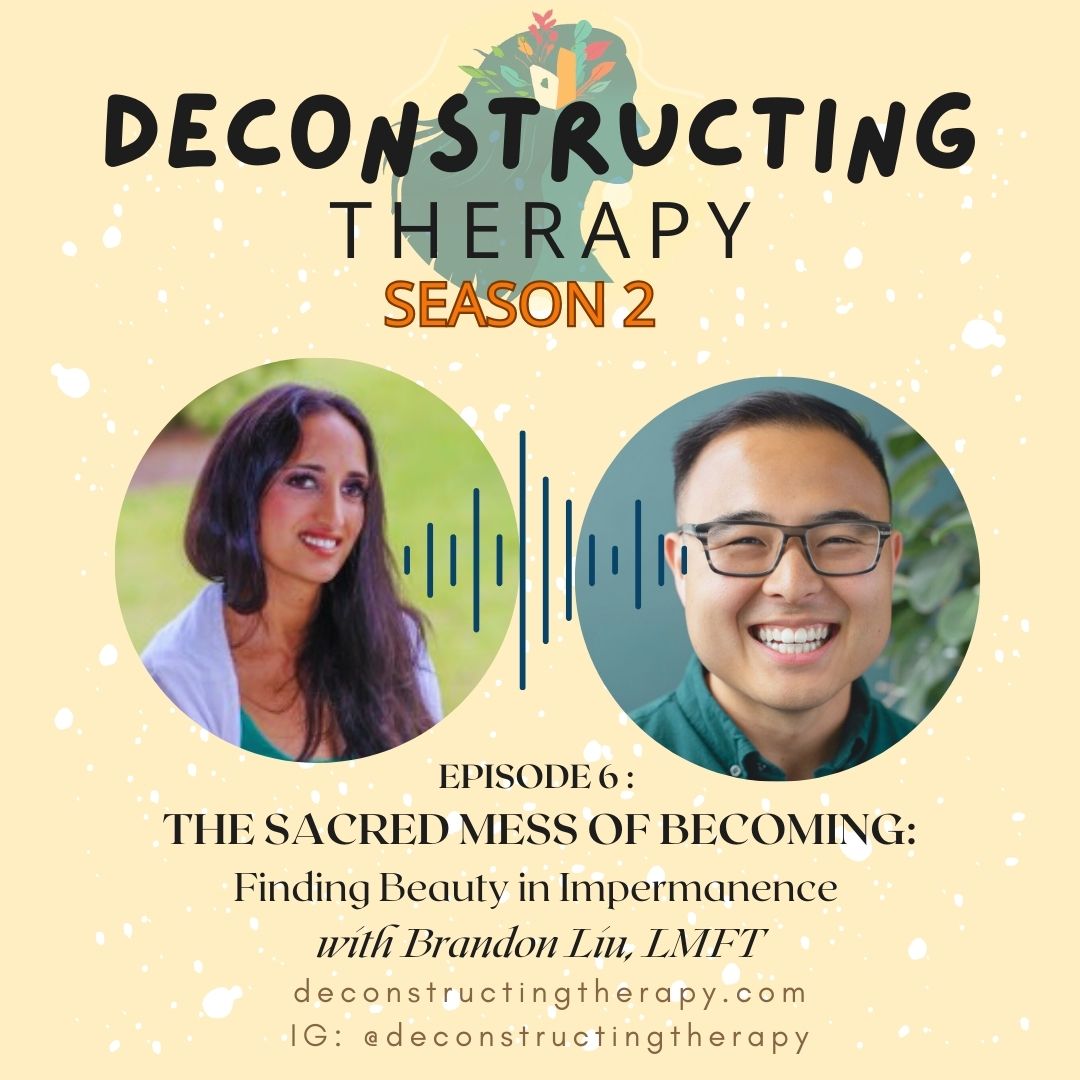
[00:00:30] Speaker B: Welcome back to Deconstructing Therapy. If you're here, maybe your spirit, like mine, knows Western therapy isn't the whole story and that the intensity of these times is revealing both our wounds and our power. Together we'll listen to powerful storytellers, therapists, teachers, activists, humans who carry both brokenness and brilliance. Their voices challenge the limits of Western model and open us to deeper ways of healing rooted in culture, justice and liberation. I invite us to lean in that our spirits fully arrive and allow this to be a pause in our day. Together, we'll reimagine what therapy can become when it truly belongs to all of us.
Brandon Leo is a licensed marriage and family therapist and a certified emotionally focused therapist who works with individuals and couples. He is a supervisor in training in emotionally focused therapy and holds a certificate in medical Family therapy. His work emphasizes emotional attunement, relational patterns, and a culturally responsive approach to healing. Brandon serves on the board of Chicago Emotionally Focused Therapy Community and is affiliated with the community of Asian Therapists in Chicagoland.
[00:01:36] Speaker A: I had wanted to be a healer from quite a young age.
I grew up the son of a doctor and a nurse. The medical field was always in my mind doing something around healing and helping others as a maybe part of the Asian identity or this immigrant story, like becoming a doctor, felt both a little cliche, but also something that I was passionate about. So I started down that road. I took all the classes and was kind of like on that track all the way through undergrad. And so I completed all the prerequisites. I even took my medical entrance exam.
But there was. There was a class in my senior year that changed kind of my outlook on life and perspective on healing.
It was a senior capstone class at my undergrad called Psychology of the Family. And when I took that class, it was led by the director of the Marriage and Family Therapy program. At my undergraduate taking that class, just so many lights went off and I began to realize so many things about these intergenerational patterns that are Occurring within my family, my family system, and the importance of relationships. All of those things pointed me, I think, in this direction of wanting or feeling like that was such a unique way to look at the world and, and reflected really well my own experience.
[00:03:10] Speaker B: Are you an immigrant yourself? Are you a second generation?
[00:03:13] Speaker A: I have no idea how to verbalize it because my, my mother is a fourth generation immigrant and my father is a first generation immigrant. So I don't know if I take the average of those two or if I'm just. If I default to one.
[00:03:31] Speaker B: Do the math. Duration. We can do that, right?
[00:03:33] Speaker A: Exactly.
My mother is fourth generation, her family is from Japan originally, and my father is from Taiwan. What's just a strange peculiarity about that is that my dad, despite being closer to the immigration event in their, in their family history, I think part of his story was maybe some hiding of his culture in order to assimilate and fit in. He came over middle school, high school, and so obviously, you know, social acceptance was really important.
I didn't get as much about my Taiwanese culture growing up as much as my Japanese culture. Yeah, my mom's family, she grew up in Hawaii, and Hawaii is very close approximate to, I think, Japanese culture in general. And so her family is both insulated in that way, but also like very in touch with their cultural roots.
[00:04:26] Speaker B: Is there less pressure in Hawaii to simulate.
[00:04:29] Speaker A: Yeah, I guess so. Or that the majority population is like Asian coming from mostly East Asian countries.
There's also, I guess a large Filipino community there as well. Yeah, maybe a little less pressure or just more of that community.
[00:04:44] Speaker B: Oh, that's so fascinating because then on the surface you'd assume that, you know, she would have lost more of her culture from being that fourth generation.
[00:04:51] Speaker A: Exactly.
[00:04:52] Speaker B: Yeah. But it just kind of goes to show our environment really shapes how we hold on to our culture and how we move through the world with it.
[00:04:58] Speaker A: Yeah, So I, I started down that medical route and then realized all these things and came to, came to understand my world in such a different way. And so I told myself, well, you know, I can still do the medical thing. I can still, but I'm going to go to grad school first for, for to be a marriage and family therapist. Because I'm just so interested in this and I hope to integrate that and bring that into my work as a, as a medical provider.
[00:05:24] Speaker B: Was there something specific that stood out to you from that class when you're saying I was learning about patterns and channel it?
[00:05:29] Speaker A: I think what stuck out most to me was the duplication of like, Intergenerational patterns between family members, like my dad's relationship with his parents, navigating that and how that shaped out shaped him. And in similar ways, things I was experiencing in my own life, maybe particularly along ideas around, you know, masculinity and emotionality and vulnerability and how both immigration as, or just any major, you know, life transition and family event can have kind of this ripple effect too.
[00:06:05] Speaker B: What were the messages you got from dad about masculinity?
[00:06:08] Speaker A: I was lucky in many regards because I know that a lot, for a lot of the East Asian community, mental health emotions tend to be either stigmatized or quieter or not, not necessarily encouraged. But my mom's mom, my maternal grandmother, actually had a really significant mental health issue. My mom was very aware of mental health in general, and between her and my dad, I'm not sure what he was like before he got into the relationship with my mom, but they were both very open and took very seriously. I think when, like, things like emotion came up. I guess what I've come to realize is that a lot of what I internalized about masculinity, about vulnerability, came from as much about what they didn't say as much as what they did say. While there was permission, I think, and room for me sharing about my, you know, experiences and internal world and my emotions, it also felt at the same time there wasn't necessarily a pursuit, I guess, from them asking me more actively about that. More like a, you can come to us when you want. And so I think from that, I internalize these feelings of I've got to kind of figure some stuff out on my own.
Emotions are okay and good to talk about, but at the same time, it maybe not always being very confident that, like, other people would want to know that about, you know, about me or that it could help build relationships or trust with other people to provide them opportunities to be there for me in that way and my parents. I should also say I'm the firstborn of, you know, an East Asian family, and that comes with all of its own expectations and messaging to quickly layer. On top of that, my dad was in the military and was deployed multiple times for long chunks of time. There was this pretty consistent messaging around, you know, what it means to be the man of the house or a leader or what that means about, you know, projecting confidence and things like that, taking care of family and particularly like my siblings or my mom while he was away. It's always so hard for me to verbalize sometimes because it's not necessarily like there was these Any toxic messaging around, like, you know, don't cry or like, don't, you know, you can't do this. But perhaps in other ways, this internalization of, like, a very private inner world that I didn't feel quite comfortable sharing or didn't. Wasn't really confident that, you know, my parents or like, other people wanted to know.
[00:08:38] Speaker B: It's really goes to show how nuanced our attachment histories are. And, like, I can really feel for, when I sit on the other end of it, of, like, what our clients feel like when we're trying to put everything into these neat little categories or boxes and in an hour. And it's like, it's, It's. It can be so complicated and like, you got all the messages and permission of, no, emotions are good. And when you came forward with them, there was all the permission in the world and for all of it. But when that curiosity about it wasn't there, it kind of shifted things for you a little bit. When somebody didn't come for you with it or when it was messy, it had to kind of become neat and you had to give yourself permission before you come forward with it.
[00:09:18] Speaker A: Right, Right. I think that really kind of captures something important that I didn't even verbalize, but I think you really got the essence of. Is that feeling of, like, needing to have it together in. On the inside before I invite someone in or before I offer that to someone.
[00:09:34] Speaker B: And is that something your dad kind of did you see in his actions kind of models by what you're talking about? Like, I gotta be this type of masculine on the outside and our military family and.
[00:09:45] Speaker A: Yeah, that's. I'm thinking of taking that question in. I'm thinking about experiences where he was. He's a really hard worker, and work takes a very central place, I think, in his life. He's the physician. His. I feel like his job necessitates some of that, like, projection of, you know, authority and confidence. And so, yeah, perhaps there was some modeling, I guess, of that ideal or
[00:10:10] Speaker B: that you have to be like that as a. As a clinician for sure. Right. If you're not confident and secure in what you're putting forward, there's already people with so much insecurities and health issues and stuff that they need that container from you. So I'm sure that served him so well in what he was doing. But at home life, then there's not as much room for that messiness of our growth. And when we're not sure of how
[00:10:32] Speaker A: we're feeling, it felt very Private. I kind of. I, maybe I use that word very intentionally other than like isolated, because it's. I didn't necessarily feel lonely all the time, but it did feel very internal.
[00:10:44] Speaker B: So when things are not completely sure and messy, that's where that kind of isolation came up for you. Is that something that still happens for you now?
Has there been any evolution on that in your realm, kind of just doing this work?
[00:10:58] Speaker A: I certainly hope so.
I feel like have been really challenged in many ways, both in my work and personal life, through relationships and also through eft, to, I think, allow that vulnerability and allow people in to those parts of me that are messy. That's been a really growing aspect, I think, of my personhood because a lot of what it's been, maybe up to this point or even before, you know, I started EFT and I was working in the field, a lot of it still felt like I could sit safely behind the professional identity, the having, having the answers in some sense, maybe in some ways even becoming a therapist was an attempt to like, feel like I didn't have to not be messy because then if I, if I just do the work and I do it as quickly as possible, then I can never have to be anxious. I never have to be. These are all subconscious thoughts.
[00:11:56] Speaker B: Yeah, no, that's a wonderful thought. I mean, that's of how you articulated that. And I wonder if that's something that other therapists go through too. It's like, I know I'm messy. I know I have all these, like, crazy emotions. Maybe I can get. Be an expert at this so I don't have to always deal with it because people assume that, you know, we've already done our work, we're healed, and everything's great on our end, but. And you talk about EFT a lot and I, I talk about that on this podcast often, about how EFT is different in that we don't gain success from becoming more and more of the expert and understanding all the strategies perfectly. We kind of gain more success by being real and authentic and in it with our clients.
[00:12:39] Speaker A: Absolutely.
[00:12:39] Speaker B: So we kind of have this mutual growth that's continually happening between us and our clients. And it can be a beautiful thing, but it, it can be intense as well.
[00:12:47] Speaker A: No, Beautifully said. I think, like, me becoming more human as a therapist was really healing. Being given that permission that, like, I can show up in the room the way that I feel, my internal world is not only allowed, but can actually be a really powerful tool for someone else. Healing as well, when I can express my inner world and that resonates with them or there's something that touches on empathy for their situation. It's been so amazing getting to see my clients, I guess, express like how meaningful that is to them.
[00:13:20] Speaker B: So.
[00:13:20] Speaker A: So it's felt very validating in a lot of ways.
[00:13:22] Speaker B: Does any kind of example or anything come to mind?
[00:13:25] Speaker A: Immediately my mind goes to the recent season of my life and this present experience.
I separated from a long term partner in the last six months or so. And being a couples therapist has certainly touched on and maybe at times we could say triggered, but definitely activated. Maybe that's a better word, like activated. That story for me and those emotions like come alive. And there's obviously our professionalism that we maintain, not asking, you know, clients to take care of us, but certainly moments and I think of one in particular where my client was going through a divorce of their own and a little, having a little bit of trouble articulating like the source of the grief and what felt so heavy about the loss beyond. Just like this person isn't in my life anymore. I had offered maybe in my own words the, I guess the, the psychobabble jargon being like, you know, the ambiguous loss of, you know, this, this future that they had envisioned for themselves. Using kind of more my own story to kind of talk about that where, you know, I, my partner and I, you know, separating or parting ways. There was these, just these waves of grief and sadness and emotion that came as like I thought about, you know, the family we wanted to build or the house we wanted to have or what growing, I guess old or like travel might look like or things like that, which brought up a lot, a lot of sadness for me. Even as I was talking about that then could just see like my client feeling impacted by that and like being able to put, start putting to words like this experience of the grief and loss. And they talk, I guess more about their hopes and what it meant to them to like become a father. Not that obviously that was off the table for the future, but just that with being a father with this other person they had envisioned. Yeah, that was really.
[00:15:16] Speaker B: Yeah, that's so powerful. I love the way you're describing this because it's. There's so often that we kind of use our own story because we're just touching on the emotions in a different way. And when we've experienced some of that, what our clients experience ourselves, we can, when we can touch on those in our own nervous system, we can really align with whatever our clients are experiencing. And seems like you really did that in like a beautifully attuned way where it's not that, you know, you bought your story to life or centered it, but it's just like, no, I can pull this out of me instead of shoving it down and playing this blank slate in the room. When you touched on those emotions, you actually utilize them to connect.
[00:15:54] Speaker A: I actually, I work with a lot of Asian men as well, and. And one thing I've noticed too is moments like those that have passed between myself and my clients has also felt like maybe a more subtle form of permission. Maybe like when they see me or I allow myself to go there in emotion, emotionality or vulner. Like they feel like more than that's okay for them to do.
[00:16:15] Speaker B: What about the other way around? Does it ever give you more permission to like, oh, actually, I can feel this too.
I'm actually telling.
Sometimes it happens to me too. Something that I'm like when I see. See it in somebody else and I'm giving them all the permission to be wherever they are with it. It's like kind of giving me that permission as well.
[00:16:33] Speaker A: Absolutely. I think when even just some, some clients came to mind recently, ways in which, like them going. Expressing like what they're going through and like them allowing themselves to be open pain or that emotion. I remember like getting off some calls and just feeling interconnectedness. Maybe that's how I'd phrase that. Like this. Yeah. This feeling of less alone, obviously. But then I can embody. I can feel, you know, these, the sadness or that grief or that pain for my, for things that I'm going through. So that's a really good point. It's very bi directional.
[00:17:04] Speaker B: It is very bi directional. And our patients will never have the privilege of knowing how much healing we're even getting together, doing this interconnected healing. It is such a powerful thing. And you can feel it. You can feel it when you're like deeply attuned to somebody and you're connecting from this deeper place that you've actually touched yourself in those emotions. So. And I know this is rough. It's just six months and it's like I, I wouldn't have a guest or even going through this. He's just such a. Together and professional and like with everything that you're doing. So that's. That's amazing. Has it been hard to be able to navigate everything as, as you know, life is getting a little bit more intense for you?
[00:17:38] Speaker A: There's certainly been moments and, and times within these last six months where I can sense like, A patience of mine wearing thin, you know, for like when I'm sitting in rooms with clients or it's really. It's caught me off guard sometimes. Really had to like kind of sit with that. Probably the hardest part, I would say I'm continually giving and like lending out. Right. Lending my nervous system to my clients and being with. And in a similar way, or I'm sorry, not in a similar way, you know, I don't expect that of them to me.
[00:18:11] Speaker B: Can you want to just clarify that a little bit? What's the difference we're talking about? Because I think a lot of people who don't understand self of therapist workers, it's like there can be these fine lines of like, yeah, we're not putting our emotions into the room in a way that is inviting others to take care of them, but we're also not shoving them down and suppressing them so that they manifested some other ways in the room either. Like, it's this very delicate art of like, can we utilize this? Can we use ourselves as a tool?
[00:18:40] Speaker A: It's a very. It is a very difficult line to figure out sometimes. But ultimately I think the question comes back to me around what is the purpose of me sharing this in this moment? If it's to help my client make sense of their experience or for me to express a curiosity in a way that allows for me to maybe get at something important or difficult question that would be a little bit hard to ask directly. If this a therapeutic purpose for me,
[00:19:05] Speaker B: then you're talking about self disclosures explicitly, right?
[00:19:09] Speaker A: Oh, yes, yes, that's true. That is true. That helps guide me a little bit more than, you know, me just sharing this because there's a feeling coming up or there's this part of my story that I'm reminded of. I try to hold on to that feeling and you know, take it to the places where I am emotionally cared for in my relationships and or my own therapy or things like that.
[00:19:29] Speaker B: So you hold onto it and you kind of slow yourself down and anchor yourself to the question of like, wait, what's my goal? What's the therapeutic value in this? And then you proceed with that. What do you do when life is a little bit more intense or something gets kicked up? You know, we're human. What are your general strategies? I mean, you gave a beautiful one with this person going through loss. You're like, let me touch on this. Let me pour out my emotions from it, tap into them and then align and you deepen their experience with them so that that seems Like a beautiful strategy right there. But what is. What are some other strategies you use when these emotions start kicking up?
[00:20:02] Speaker A: It's very much a work in progress, I'll say that much.
I was reminded recently in a therapy session of my own. I was describing some of the intensity of emotions that can come up and in the work that I've been doing, and especially again, going through a separation of my own and then doing couples work, I don't know how much closer you can get to the experience.
But my therapist was like, what would, what would you say to yourself in this kind of a moment? Like, how would you guide yourself if you were to. I was like, you know, I thought, I'm paying you to tell me. No, no. She was very gracious and very kind. And I think where we got to kind of in that dialogue of me considering, like, what is helpful for me or what would I kind of say to myself if I were on the outside, was just the emphasis around self care in, like, it's the way it's supposed to be practiced. And maybe I'm putting a lot of preface or caveat there to emphasize something that I want to distinguish, which is sometimes when I think people think of self care, it looks more like self indulgence or like kind of seeking after that dopamine hit, or just something that feels good. And what it actually looks like is doing the things that I know are good for me, even though I might not want to do them or might not have the motivation for them or simply because they are aligned with my values or I know that are just help me become more fully balanced and human. It was kind of a return to basics, I guess, in some ways.
[00:21:32] Speaker B: And I really like that distinction because there's, you know, self care. The word has exploded into all of the things. Capitalism has kind of taken a hold of it and means like, oh, buy more beauty products and take more bubble baths and stuff. And. And what you're really speaking to is like, you're slowing down and really going to that part of you and saying, what's my need here? What does this part of me need right now? To feel cared for.
[00:21:56] Speaker A: Exactly.
[00:21:56] Speaker B: And that might not even feel good in the moment. That might feel more challenging. It might mean I have to bring some rough things out of me and then attune to them and tend to them. But that's the real deeper self care. And then when you're in these messier moments in life, kind of realize like, hey, if I don't do this, that I. I can't be a therapist, I can't be with my clients and be actively suppressing my own needs at the same time. It kind of forces you to be in those moments a little deeper.
[00:22:23] Speaker A: Yeah, absolutely. It feels kind of like trying to draw from, like, a well that is completely dry or, you know, without. Without water. I know I'm getting to that point when, when again, my, My patient starts wearing thin or I can feel like, resentment creeping in or that sort of thing. Or avoidance, I think, is a pretty good, pretty, pretty big strategy for myself sometimes.
[00:22:43] Speaker B: What were the strategies that you grew up with or what are the strategies that you witnessed in your family system? And then how much of this feels like it's resonating with your Asian identity?
[00:22:53] Speaker A: I think work and my family's relationship to work has played a really big part in the strategies that we've. We utilize to manage difficult emotion and vulnerability. It often becomes, I think, kind of a competing interest in many ways when we're going through hardship to just use work as a way to, like, derive fulfillment and distract us in some ways or make us feel good about ourselves and self soothe. Maybe another form of avoidance, I guess I'd say.
And that's kind of backed up maybe by some of our cultural values too, like the value around, you know, being prominent in our field or like, being accomplished in our careers.
Or maybe there's also an element there around the immigrant story too, about being successful, carrying this legacy forward, bearing this responsibility and torch of previous generations who sacrificed so much, you know, to provide me with these opportunities. I think those kind of coalesced altogether to make me feel kind of a pressure to, like, move, like, get that accomplished, get that certificate, get that accolade, this microcosm, I guess, of avoidance, or it allows me the, the, the avenue of avoidance. When it came to emotions and vulnerability in my family, I don't villainize it because I think there's. There's also some goods to that. And I obviously wouldn't be here today where I am without that. There's pieces, I guess, that also had to be quieted or pushed down or given up in moments like those in order to, you know, manage and like, feel better in a, In a really difficult situation.
[00:24:30] Speaker B: Yeah, it's so nuanced. But, like, what you're saying is when there's tough spots happening, there's emotions that get kicked up, you learn that I can channel this into work. And there's a lot of beauty in that. Right. Because I can still function, I can still keep going forward, and I Can actually. Actually be of service to other people, my community. Take care of myself, even when these things are going on that are intense. But when it gets a little bit too overburdened, that suppression can kind of become heavier than it needs to.
[00:24:57] Speaker A: Yeah. Or isolate. I think oftentimes maybe, like, cutting myself off from people who would want to see that vulnerability or, you know, care about me in those ways. Because, like, to engage with them would mean I'd have to, like, touch on emotion.
[00:25:13] Speaker B: That's valid. Are you aware of that at the time when you're pulling away, doing that? Avoidance?
[00:25:18] Speaker A: Sometimes. Sometimes it is a little bit more easy to notice in. In this season of my life because I live with my best friend.
So when I feel that, like, wanting to distance, that often, like, cues me, like, I gotta lean in. Like, there's something here. There's something I'm trying to, you know, not talk about or avoid or something that I'm worried he'll ask about and that I'll have to actually feel and touch.
[00:25:43] Speaker B: That's good. I mean, it's good to have friends like that. And it also kind of speaks to. When I think generally of just a lot of Asian cultures or the way they grew up and, you know, what society had. They didn't have the opportunity to have those spaces where it was safe to bring out those vulnerabilities. So them channeling it all into productivity and work was like. They didn't have the other option. So it was, like, very beneficial.
And I know those strategies remain generation after generation, but we kind of. We have the privilege of having spaces where it's safe to come out with them.
[00:26:16] Speaker A: It just requires, like, our courage to be willing to move into those uncomfortable spaces. And there is this. Yeah. Legacy. It's a lot easier in some ways to just rely on those, you know, ways we've been taught or the ways that we've. That have been modeled to us.
I think about, like, what's. Again, what's important to me in my life and how would I want culture and history to be honored? I guess, in the way that is meaningful to me. Being a part of community and being, like, more fully me and, like, whole feels like the best way to do that.
[00:26:52] Speaker B: Yeah. I mean, I love that you're on this journey and you kind of went through something very intense six months ago, and I'm sure, you know, for how much longer before that, and you really pushed it to become more authentic and pull this stuff out of you, like, undoubtedly can guess that it has made you even a More powerful therapist with your clients.
There's a reason why therapists have had a lot of trauma history. It's because they can utilize it to really connect with people.
[00:27:21] Speaker A: That's kind of what it is, isn't it? Maybe that's how I'm coming to see it, I guess is we're not kind of this blank slate, obviously, or we can't really section off parts of ourself. But our fullness and identity is so important. And again, I know there's this professionalism we want to. It's still, you know, a professional identity at the end of the day, but also that it's. I don't know, I just hold so sacred like these moments where people and like our souls are kind of meeting, you know, in this particular moment, in this space and time, but also like struggle and this bi directional feel of like, you know, we're coming, becoming more fully alive and more of who we are and whole and balanced that I feel like is really only possible in this relational sense, like with others and in dialogue. So I don't know, there's something really.
[00:28:07] Speaker B: Yeah, no, that's very powerfully said. This bi directional healing and this hold and it feels different. Doesn't it feel different in the room when you're like fully aligned with your client and you're tuning and you're like deepening each other's experience?
It can be such a powerful thing. Yeah. And it does come from being able to touch on things that we've. Our nervous systems have touched on and experienced ourselves.
Yeah. Really appreciate this conversation.
Is there anything people are listening to it? We've talked about a lot of things. I think a lot of self. Of therapist things and struggle. Is there one or two things that you would want the listeners to take from this? Maybe some other therapist that's kind of on this journey themselves and trying to be the best at it right now. How do you do it as yourself?
[00:28:54] Speaker A: Well, what's really sticking out to me is just the importance of, of the messy. I think messy feels scary in some senses. It feels risky and vulnerable. But through that bringing others along for that messy part does feel like we get to experience maybe that acceptance and that love and that care that touches our hearts in like the deepest way possible, I think. What? Oh, I mean, for me at least I'm really, you know, craving and wanting in life. And reflecting on today's conversation, I. I did have this Japanese philosophy that I've been really sitting with over the last few days. The term for it is mono. No oware. It's a little bit related to Wabi Sabi if people are familiar with that kind of the beauty in the imperfection. But this one is a little bit more like beauty in the impermanence in life. I feel like I've. I don't know, that's really been like, alive and touching, touching me lately. Maybe in part because my roommate and I are watching a lot of anime, but also because maybe a part of me just realized it's. Maybe it feels a little cliche, but. But I don't know. There's something so, like, heartwarming to me about just knowing that, like, certain things will end or certain things will change or things, some things won't always be around. That feels like experiencing it in this moment feels more vibrant and warm to the touch and significant to me.
[00:30:17] Speaker B: Yeah, that's really powerful. I'm sure I'm going to sit with that in a deeper way after this conversation, but I never thought of it that way because, yeah, we think uncertainty is life. There's always transitions. It's just something you have to accept and be able to flow with and move. And I've come more and more to that mindset. But the way you're saying it is like, no, there's actually beauty in that, that things are ending and changing. It's not just something you have to learn to flow with. It's like knowing that and having that deep awareness allows you to be more radically present in your moments and have gratitude and appreciation for everything that you're experiencing.
[00:30:48] Speaker A: That's perfect.
You said it so well.
I love that.
[00:30:52] Speaker B: It's definitely going to shift some things for me also. Do you want to just let people know where to find you, how to get in touch with you about your work, or maybe your therapy sessions? Brandon also does. Do you do 12, 16 hour. What kind of intensives do you do?
[00:31:07] Speaker A: I'm pretty flexible with intensives just based on what the client needs. Obviously, for people that I don't have established care with, I prefer for it to be at least, at least two days, if not three, just for them to get the maximum value out of that time together. But I own the practice called Hazakuda Counseling. I seek to foster relational health and wellbeing for Asian identified couples. Asian men. And I also work with a lot of healthcare professionals in the Chicago area. Yes, I offer intensives for couples who are looking to do some concentrated work around their relationship. I've helped support people who are in individual therapy who want to work on their relationship or for people who Just feel a little bit stuck in their couple's work.
[00:31:49] Speaker B: Okay, is there a website that has all this information that people can find you?
[00:31:53] Speaker A: Yes. If you're interested in attending our annual conference, that would be at www.caathch.info there'll be information about our annual conference on that website.
Or you can reach me on my own website at www.hazukudacounseling.com.
that can be a little hard to spell for some. So that's H, A Z, A K, U, R, A.
[00:32:19] Speaker B: Wonderful. What does that mean? I'm guessing it's Japanese.
[00:32:21] Speaker A: It is, yes. And it comes from Sakura season, actually. People are familiar with that where the cherry blossoms fall, and it's really beautiful in Japan and there's lots of tourists.
But it comes from the period in the season where the flowers are starting to off the tree, or rather most of them have fallen off the tree, and in their place, they're starting to grow these green, verdant leaves. In one sense, it's referring literally to that point in time of the tree's life cycle, but in a more philosophical, metaphorical sense, it's supposed to represent the beauty and change and the beauty that can be found in. In, like, the newness. Even though something like a flower which is really beautiful and impermanent in many ways, like, as that falls away, like the things that this kind of more sturdy, functional, but also like, beautiful green leaf is coming into.
[00:33:11] Speaker B: Oh, yeah. There's so many aspects to that metaphor with therapy. That's perfect. It's great to have you here, Brandon. Yeah. Looking forward to hearing more and learning more from you in the future.
[00:33:21] Speaker A: Absolutely. Thank you for having me so much.
[00:33:24] Speaker B: Join the movement and keep the conversation
[email protected] and follow us on Instagram, Facebook and TikTok at deconstructingtherapy. If you found value in today's episode, please subscribe and rate us on Spotify and Apple Podcasts. If you are able to and would like to help sustain the podcast, you can find us at buymeacoffee.com deconstructingtherapy to show your support.
Thank you for listening.