[00:00:00] Speaker A: We can talk about the merits of like how we're taught about therapy, but one of the first things they teach you when you go to therapy school is like Carl Rogers authenticity and being genuine and congruent. And that's just like, that's just what I'm doing through and through. But it turns out that when you do that, most therapists in the dominant they don't like that too much. So you have to start wondering why, why don't you like that? What does it threaten?
[00:00:22] Speaker B: Welcome back to deconstructing therapy. If you're here, maybe your spirit, like mine, knows Western therapy isn't the whole story and that the intensity of these times is reveal both our wounds and our power. Together we'll listen to powerful storytellers, therapists, teachers, activists, humans who carry both brokenness and brilliance. Their voices challenge the limits of Western model and open us to deeper ways of healing rooted in culture, justice and liberation. I invite us to lean in that our spirits fully arrive and allow this to be a pause in our day. Together we'll reimagine what therapy can become when it truly belongs to all of us.
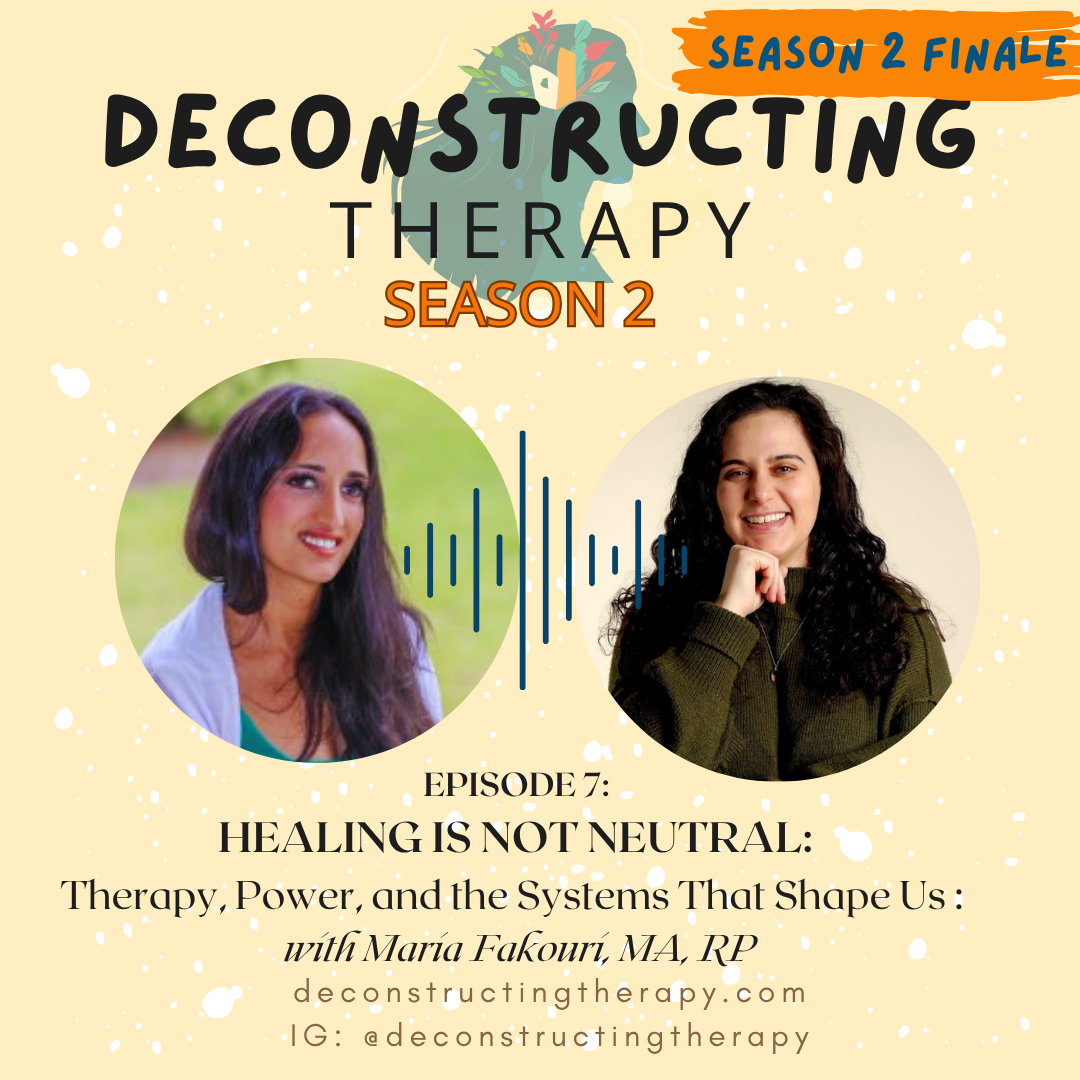
Maria Fukuri is a Palestinian therapist offering anti oppressive trauma informed psychotherapy in Ontario, Canada. Maria invites therapists and communities to move beyond individualistic models of care and towards approaches that are more relational, culturally responsive and grounded in justice. She writes and speaks powerfully about mental health through a liberation focused, anti colonial and neuro queer lens, centering the lived realities of Palestinians and others navigating trauma under systems of oppression depression. Her work challenges mainstream therapy to reckon with power, violence and collective healing. I'm deeply honored to have her here with me today. It's so good to have you here today. You've been such a good inspiration for me. A good reason that I, I brought you on is like my world kind of split apart. After everything that's been going on the last two years, my therapist world and my activist world and I, my activist world kind of saw the reality that I was living in and my trauma. And then in a very bizarre way, the people that always saw it didn't and it just fel very disorienting. And there was several posts from you that like just calmed my whole nervous system down. It was like, oh my God, okay. I feel seen, like this is where both of my worlds meet and someone's naming all the stuff that felt so uncomfortable and disorienting for me. Thank you for that. It's, it's been very meaningful to me and I'm just So honored to kind of get to know you on a more personal level today.
[00:02:23] Speaker A: Oh, well, thank you so much for inviting me. I'm so. I'm still, like, continually humbled by the impact that my words were able to have over these last two years. It's, like, still a surprise to me that people needed to hear that because I needed to write it. So thank you for inviting me. Of course.
[00:02:41] Speaker B: So, I mean, how. How was that task to write for you? Was it. Are you just a writer in general? Was this something that you were just drawn to? How did you start?
[00:02:50] Speaker A: I have always just been very wordy, and I've always loved to write and love to read. And when the, you know, the genocide quote, unquote, began. And I, you know, I take trouble with that, that term, obviously. But after Al aqsaflah, October of 2023, I knew, right, that I was a therapist, a Palestinian therapist. And I knew that very few people were going to be, one, qualified and two, like, courageous enough to actually serve the Palestinian community in how we're going to move through this atrocious thing that we not only have to, like, witness, but also fight back, survive.
So I just started talking and here we are.
[00:03:32] Speaker B: So it kind of came from, like, knowing that there's this entire population now that's not going to be served.
[00:03:38] Speaker A: Absolutely.
[00:03:39] Speaker B: That's wonderful. And I hope you were able to get through to some other therapists. And I think it's some of your post to. You wrote, like, it shouldn't be all on us to actually serve this community either.
[00:03:49] Speaker A: Yeah, that was one of the most absurd things about the last two years, mind you. I. I'm working on reframing myself and, like, decent. The white gaze of, like, these white colleagues, or even colleagues who are not necessarily white, but uphold this, like, structure of apathy where genocides can happen. But that's not relevant to psychotherapy.
But it is really absurd that for somebody like me who's Palestinian and a psychotherapist, I now not only have to, like, watch my people being massacred, I have to fight back on. On the level of just having my own human dignity as a Palestinian and, you know, standing up and saying, this is wrong, like, my people are not up for debate. Our existence is not up for debate. And then I have to have my own practice to continue paying my bills. And then because so many of my colleagues were not willing and are still not willing to do it, I also feel a duty, right, to provide some kind of sustenance for Palestinians, especially Palestinians in diaspora Who I can speak to the most.
[00:04:49] Speaker B: It's stuff that you shouldn't have to hold that. That's a lot. Like, I'm going through this trauma myself, and then I have to be called to help the other people going through this trauma because they're being ignored so much on this other end. Yeah, I want to hear your experience of that as well. And also what you said of, like, I am shifting away from the white gaze. That is something that I am continually kind of working on myself.
I think a lot of us, Muslims, Arabs, like, we kind of. We have some of this white proximity privilege that we've had, and, you know, that we've been more aware of since the genocide happened. And I think a lot of our reactions has been like, no, no, no, come on. Like, let me pull you guys. You used to hear me, like, you can see me, like, flee and beg to the dominant culture to see us and hear us again. Because they used to.
[00:05:36] Speaker A: They used to.
[00:05:38] Speaker B: Maybe our black siblings don't have that privilege that we had before. So let me. And I see you kind of light up like, yes, they used to. So kind of expand on that. Tell me what some of your experiences.
[00:05:48] Speaker A: The word that comes to mind is jarring.
I graduated from my master's in psychotherapy in the spring of 2022, and that program is called the Master's in Counseling and spirituality at St Paul University in Ottawa. I name them because they are complicit. So I graduated, and at the end of those two years, two of my professors hired me for their group practice. And so then I worked for this group practice, a predominantly white group practice, for two years. Those were, you know, I'm white passing. Right. I mean, some. Some folks might disagree, but for the most part, I can live in that privilege. I can live in that. That erasing of difference. And it didn't. It didn't occur to me that I was doing that. But then, you know, as of October of 23, then, I became suddenly very aware that I'm a racialized person, and we can't really avoid that. But to bring it back to how they used to. Right. I saw the way that there's a before and after in my life as a therapist. So before, you know, I'd have colleagues come and they want to consult me. They want to ask me on this topic or that topic, what does Maria think? You know, because before I was a Palestinian therapist, quote, unquote, I was Al Qaeda. Like, I was a therapist of other things, religious trauma or queerness or. I don't know, relationships. I have other specialties. Right. And they would come and they would want my input and to have dialogue, to do group supervision. But then as soon as I declared myself a Palestinian, suddenly all of that trust and it all goes out the window because suddenly that's all they saw. So that was a big. It was jarring. It was very jarring and something that I have really had to reckon with.
[00:07:29] Speaker B: And yet I can see this still, the pain in your face, because it's, it can be extra jarring because they're coming to you because of your marginalized identities. Oh, you work with queer people. Oh, you're, you know, you're racialized in this way, but in this vague way. And that almost brings people some clout a lot of times when it's in a safe way. But now, like, oh, no, no, no, not the Palestinian or being Muslim or, oh, no, no, we don't, we won't get too loud about that.
[00:07:56] Speaker A: Yeah, help us be culturally competent, but not too much.
Don't take it too far now.
Oh, so silly.
[00:08:05] Speaker B: It is. It is silly and you can laugh at it. But yeah, I think that jarring is like the perfect word for.
[00:08:11] Speaker A: Or.
[00:08:11] Speaker B: Because when you see conservatives or people who are like, no, I don't want to even go in that world at all, that's different.
But when you see these liberals who make their entire identity about being culturally competent and trauma informed.
[00:08:23] Speaker A: Trauma informed. That's. See all of these terms, I just started to find them really funny because what are, what are any of you people talking about? There's a genocide. There's more than one genocide. I want to be clear when I say the word genocide. I never want to be erasing the genocides in Congo, in Sudan and Tigray, or on Turtle island where we are, or at least I think you are. So forgive me when I say the word the genocide, and it's just in relation to me being Palestinian. But yeah, suddenly you realize, like, oh, trauma informed. But we're not going to be informed about this trauma. This trauma doesn't qualify. This trauma is inconvenient, actually.
[00:08:56] Speaker B: How do you make sense of that,
[00:08:58] Speaker A: of the people who do the work? Up to a point, I guess. You know, for a long time I thought I could convince them, Right. And that goes back to the appealing, appealing to their gaze. Right. I felt like surely, you know, they just don't understand enough. Right? Or once it's explained to them, or they understand how everything's connected, then. Then surely they will come and, and join us in the in the light just being just scientific. I have an undergrad, an honors in psychology, right. I wrote a thesis, I worked in research, I research lab, right. I was a research assistant.
I come from a very academic background. So these people are all about science, right? Psychology is a science. But then they don't want to be, I don't know how they define science because as far as I'm concerned, we're observing the world and then we're, you know, drawing certain conclusions, but they don't want to observe the world. And so I thought, you know, if I bring in the fact, right. If I bring in the information, then you know, these science minded, you know, the, what do they call it, the, the scientist, clinician or whatever, surely, but they don't. And so then for a while I was like, okay, so they're cowardly, they're afraid. And I guess that's where I landed in the end is that it's not acceptable. Right. And it stems from racism and dehumanization. But eventually I was like, okay, some people, truly some therapists, for them, therapy is their job. They go, they clock in, they sit with whoever is going to pay them and then they go home and they want to keep their work in a very specific bubble. So if they have a client who walks into their office, let's say they're not even Palestinian, let's say they're not even, you know, brown or Muslim or Arab or, or black or anything even just, you know, let's say a white person who's concerned about, you know, genocide or concerned, you know, especially about the genocide of the Palestinians, that therapist is going to find a way to shut them down because that doesn't fit within their framework of what I'm willing to hold in therapy. And I think that that line at the end of the day, it's, it's cowardice.
[00:10:55] Speaker B: Yeah. And it is sad. And I've had so many patients kind of come to me saying I went to other therapists and kind of, they couldn't hold this trauma or they would, you know, oh, you just need to stop watching the news or you need to contain this and just trying to internalize what was really like a normal reaction to such intense injustices that we're seeing. So I appreciate that and I guess for you it should just kind of calm down like you've gotten some acceptance and peace from this is just cowardice. I can't change it. I'm not going to keep begging for crumbs at their table and getting to be seen so I appreciate that so much. And I've, you know, I've been on a similar journey. I slip down often and try to knock at the door again. And I don't want to even center this conversation on that either.
[00:11:38] Speaker A: It's not, I hear you.
[00:11:39] Speaker B: Absolutely worth it. Tell me about your shift then. Like, hey, I'm remarketing. I'm not trying to get the white gaze anymore. What are you filling that space with instead?
[00:11:49] Speaker A: I. I have this. This really unique positionality as a therapist, because being Palestinian and also, you know, a good writer, a good communicator, also, you know, being the grandchild of Nakpa survivors, Right? So, you know, all four of my grandparents are survivors of the 1948 Nakba. And I was raised on the Necba stories. And I saw my grandparents lived a lifetime of living in these Western countries where we, you know, had to end up, where they ended up as refugees eventually, right after the Nakba. And nobody believed those stories. And so suddenly, when the narrative starts to shift after October of 23, it's like, okay, first of all, forget about my job as a therapist for a second. Like, if this as a person, as a granddaughter, as a woman, as a Palestinian, I'm going to do activism. And that's what I've always done. Not always. I think that's a bit dishonest. But, you know, throughout my life, there have been periods of time where Israeli aggression would really escalate. And, you know, I'd spend a few weeks going out to the protests and tweeting some stuff, and then I'd go back to my, like, little Western life. But this time, everything just went out the window. And, you know, I knew it was different. I ended up in this really unique situation where I can't add, I can't do advocacy for Palestine without telling my story, without talking about my family, without talking about my history and my pain. Also, because if therapists are not going to acknowledge genocide, I can't help my community processor heal and act as if I'm done processing or done healing.
And sometimes the best thing I can do, often the best thing I could do in the last two years is just to word my pain, share my pain, put my pain into words so that other people can see themselves mirrored in that feel mirrored and have that relief and feel grounded and know that, you know, somebody else feels in. They're not alone. But what that has meant is that I've ended up being extraordinarily vulnerable to, like, a lot of people.
And that is not something that is very Typical therapists, right? Most therapists, their clients sits across from them and doesn't know anything about their life. But for me, suddenly I have clients who were my clients, you know, for years before, who suddenly learned a lot about me. And then I have clients who have found me through Instagram, having followed me and seen me on a very deep and personal level for two years. And they see me make mistakes. You know, they. They see me in the comments sections. It's very vulnerable. And so that has almost created a unique therapeutic orientation that I have now where it's just like, I'm just a real person. I'm here, I'm in the community, you know, I'm not just some kind of, like, expert or healer who's going to, like, fix your problems. We have. We all have this big problem together, right? And I am not separate from that. And at the end of the day, in the room, I might be the therapist and you're the client, but in the streets, we're fighting oppression. It's funny because, I don't know, we can talk about the merits of, like, how we're taught about therapy, but one of the first things they teach you when you go to therapy school is like Carl Rogers authenticity and being genuine and congruent. And that's just like. That's just what I'm doing through and through. But it turns out that when you do that, most therapists in the dominant, they don't like that too much. So you have to start wondering, why. Why don't you like that? What does it threaten?
So it all unravels from there.
[00:15:01] Speaker B: And what did it kind of unravel for you? Because even I used to do this and go into the streets and then go back into my Western world and put on that hat, and now that doesn't even exist. I'm just one person.
I'm not this therapist self, this Western self, this. It's like this has become so big. I have had to drastically become authentic in every space. I can't hold it. How has that been for you, even just being vulnerable online? And has that felt overall good for you? Has there ever been a space where it's like, you know what? I want to protect certain vulnerabilities for myself or in other protected spaces.
[00:15:36] Speaker A: Okay? So in some ways, it has been incredibly affirming because I'm queer and I'm Palestinian, and I'm a woman, and I'm a Palestinian Christian. So that's like. There's so many, you know, minorities within who I am. A huge part of it has been very affirming and empowering that I could take these ways in which I've been marginalized and I've been oppressed and actually, like, alchemize them and give them back to the world and. And that people could be like, wow, I've never seen someone like you before. Someone like you. Someone like me. Thank you.
Whoa. Like, that's the honor of a lifetime. But it has been. The vulnerability has been difficult.
Yeah. One of the biggest honors of my life, truly. I. I actually can't believe most days that I've gotten to do that with my life, with my story.
[00:16:18] Speaker B: No, that's beautiful. And I. I can see, you know, I'm sure all the people that you touch and can calm other people's nervous system. That feels so good for you. Is there. How is it for you to be out there?
[00:16:28] Speaker A: You know, it's only started to hit me very recently how public I am. For a long time, and especially in the first year or so, in my head, it didn't feel real. I'm just like, here I am. I'm just like a girl on her phone, you know, like, texting out my thoughts. And it didn't feel real. It almost felt like a game, you know, like, oh, a thousand followers. Cool. 2000. It just. I see, you know, I saw numbers, which is. There's a conversation about dehumanization there, but I'm not going to go there. But I think I had to take it down a notch in my head and kind of not see it as something that was real. That, you know, a thousand people is really a thousand people. Two thousand. Now it's. Now it's at 46. I don't. I don't say that out of any kind of, like, arrogance or grandiosity, but it's like, oh, this is a big audience. And so I have had to kind of forget about that in my head, like, forget that there are real people on the other end of this that are watching me.
[00:17:17] Speaker B: And that comes through, I think, too, because you stay authentic. You don't look like you're in audience capture where you're adjusting yourself. And I think that's what is appeal for you as well.
[00:17:27] Speaker A: Yeah. And then lately, you know, I've had to have a reckoning in the last few months, especially where I was like, whoa, I just poured out my whole soul to the Internet for two years, and all these people said, oh, my gosh, that's a lot. So I have to have conversations with myself regularly where I'm like, It's okay. Like, you chose this. You wanted to do this. You did this out of principle. And, you know, I think there's this part of, you know, all of us that's, like, socialized to hide or, you know, be embarrassed by our vulnerability. You know, all this kind of stuff that we help people work through in therapy, that exists within us, too. Right. So I'm. I'm having to come back to that, be like, it's okay. It wasn't cringe. You know, all the stuff you say,
[00:18:03] Speaker B: how has it impacted your work, how your. Has impacted your relationship with your clients? Just you being more boldly, you.
[00:18:10] Speaker A: I'll speak for the. The clients who have been with me from before, who had me as a therapist for, like, a year and didn't know anything about my life. I don't want to speak for all of them, and obviously not all of them really follow me or have kept up with us. You know, only a handful. But the ones who have, I have seen be very positively impacted by this. They're more assertive at work. They don't tolerate abuse. They're braver. They question the ways that they oppress themselves and internalize oppressive narratives about themselves. It has been, for many of them, very empowering. And I have seen them. Seen them be positively impacted as a result.
[00:18:45] Speaker B: That's beautiful. Yeah. So it's just. You're standing up and saying, no, I'm not going to be oppressed in any levels. Touched other people's version of oppression and increased everybody's courage around you. That's beautiful.
[00:18:58] Speaker A: Thank you.
[00:18:58] Speaker B: Has it shifted, and have you lost certain clients? Has it shifted the type of clients?
[00:19:02] Speaker A: You see, the environmental shift has been huge because I used to work right in a group practice in this, like, house with a bunch of therapists. Wake up in the morning, go to work, and, like, say hi to this person, hi to that person. Now I go and I have an office by myself. And at first, that was very isolating, uh, but also liberating to be, like, liberated from the judgment, the judgmental eyes in terms of my clientele.
Have I lost clients? Probably, But I. I wouldn't say that I lost them out of necessarily, like, conflicting viewpoints. Cause I don't really think that I had Zion as clients or anything like that in the past. Or, you know, it hadn't come up. If I lost clients, it was because I was grieving and I couldn't show up. Right. And I had to take, like, several months of leave. And this is one of the things that our profession has failed us on. In my code of ethics, at least there's one. The, like tenants of. That is, like, support for colleagues. But there was none of that. And that reflects back on my clients. I've gotten much better at this, like, wild thing that, you know, I don't think any therapist should ever have to get better at, but. Right. To, like, to witness a massacre on your cell phone of people who look like you, like your family members, and then put that phone down, take a moment to ground yourself, and now we're going to be in session with somebody.
[00:20:16] Speaker B: Yeah, it's jarring. The word jar. Jarring just keeps coming up. That's. Yeah, that's what I had to do over. And also the transition sometime for me of, like, seeing Palestinian clients who are grieving with me who are losing people and then transitioning to other clients within minutes of, like, okay, now we're going to talk about dirty dishes or something, right?
[00:20:36] Speaker A: Like, yeah, yeah, yeah. That. I don't know. Did you find that there was a learning curve for you and how.
[00:20:43] Speaker B: For sure, it was hard. It was hard. Like, people would say, oh, it's so hard for you, probably, to see Muslims and Palestinians and stuff. I was like, no, that's. That's not the hard. The hard part is seeing everybody else, because my mask is down. I'm grie. We're collectively grieving in these other sessions. I can say, hey, I'm. I'm kind of doing this alongside of you instead right now. But really having to hold up, that was the hard part for you. Did you find that to be the same for you?
[00:21:09] Speaker A: Absolutely. I had a lot of people in the beginning be like, wow, it must be so hard to be a therapist right now. And I was like, yes, it is, and it has been. But I'd rather be doing that, like a job that is meaningful and where I can see the tangible impacts of, like, helping people heal in, you know, a hurting world, rather than, like, going and sitting at a desk doing something that doesn't feel meaningful at this point.
[00:21:33] Speaker B: Yeah. We get an opportunity to really channel some of our grief into and mobilize it with what we do. Yeah, that's. That's a really valid point.
[00:21:40] Speaker A: And at the same time, though, yeah, there has. There was definitely, like, an existential career crisis when the client who's in this. In session with me isn't necessarily marginalized or paying attention to genocides, meaning in my work is so important. And so once I started to realize that, like, oh, hey, is maybe the dominant framework of therapy is Just here to, like, help people regulate themselves enough to go back to work. To work. That desk job that I don't want to do, to. To fit into the. To be that cog in the machine. It, like, it broke me down. I was like, okay, I need to find a way to actually integrate all of this so that that client who's here to talk about the dirty dishes is still part of the larger story of, like, what has happened to humanity.
[00:22:25] Speaker B: Beautiful. Like that. That's kind of. It's really. Does mirror my exact journey too. It kind of being like, no, it's. Oh, these are the people suffering with this. These are just these privileged people. No, no, no, no. We're all suffering from the same thing. We're on different sides of it and having different experiences of it. You might be getting frustrated with the dirty dishes because you're in grind culture right now, and you're just feeling like your worth is your productivity. And it's just. It's all.
[00:22:51] Speaker A: It all stems from exactly the same system. So then we stop doing the othering, right? Cause I guess there's an angle where we're saying, like, this person is other because they're not suffering like us. But it's like, no, everyone suffers under this system.
[00:23:03] Speaker B: So tell me about how that adjusted. You're like, well, I had an adjustment period. How. How have you adjusted? How do you approach people differently with this kind of framework of like, oh, my God, I have this really deep awareness of this system and how it's weighing on all of us.
[00:23:17] Speaker A: Well, I will say, like, I was reflecting on this yesterday.
So now the clients who come to me, for the most part, tend to find me through Instagram. So they find me as an activist, and they're like, oh, wow, this. She happens to be a therapist too. That's cool. Like, you know, and then they'll book an appointment with me, whereas I used to. And maybe you'll relate to this, right? Like, I'll. I'll see a client for the first time, and intake is like, tell me about your childhood and tell me about growing up. And, you know, I'll do a little, like, set that foundation where therapy starts from the individual, and then we find out the other. The other pieces of their life as time goes on. And now instead, people are coming to me being like, hi, Maria, nice to meet you. The world is on fire.
And so rather than learning a person from the. From the individual outwards, it became actually like, we start with the world and then how you're impacted by the world and how it gets closer and so it's almost switched in its, you know, directionality or something. How I get to know a person, even?
[00:24:18] Speaker B: Yeah. So it's almost like, hey, we're in this together now. Let's get to know each other. But let's. We're already starting with the context that we are in this fire together then.
So I guess you putting yourself out so authentically, you're really just attracting more people that are probably aligned with you.
[00:24:33] Speaker A: I'm sure you. You know, you. You've experienced this too.
People are hungry for therapists who aren't trying to spiritually bypass the world. I know you. You've heard them, I'm sure. Like, I have heard the. The most egregious stories about the ways that therapists are gaslighting people.
[00:24:50] Speaker B: Can you. Can you speak on that a little bit more? And, you know, for even people who don't understand spiritual bypassing, I think that
[00:24:57] Speaker A: the dominant framework of psychotherapy wants you to cope. Right. The world happens, and we can change our thoughts and we can have a more positive attitude about it. And if you can't do that, then something is wrong with you. Right. Like, we haven't cracked the code of, like, what is this disorder that you're dealing with?
So when this all started and I was still working for the group practice before they terminated me, they were very alarmed by my grief, right? They looked at me like I was some kind of alien because I was upset about these massacres.
These people who had employed me were like, you just have to get through it. You know, it's like. It's like when parents have a. One of them told me, it's like when, you know, parents have kids who get cancer and they still figure out how to go to work. And, like, you can also do that
[00:25:42] Speaker B: also, people wouldn't be like, well, I don't know if your kid really has cancer. Can we not call it cancer?
Can we just say it might be a little bump in their body?
[00:25:51] Speaker A: Right, right. Yeah, yeah, yeah, right. Oh, well, you know, your kid's cancer is not as important as this kid's kid. Like, we can. We can break it down, you know, infinitely. But just this idea of, like, how dismissive that is, that therapists are telling people that this is within the range of what you are supposed to be able to handle and positively think your way through. So that's the spiritual bypassing, right? I mean, like, think positive thoughts and, like, look on the bright and you focus on your breathing, focus on yourself. Right? All of this is to detract and distract away from, like, the reality outside of the counseling office. Exactly.
[00:26:31] Speaker B: And it's such gaslighting. Right. And people need you to share in their outrage about what they're seeing, whether it's the genocide, whether it's just anything in reality. Right. And I think we tend to do that with a lot of things. They might be outraged by something that happened at work that is an injustice that's happening to them. And I think when the reflex is to always, oh, how are you handling this? How do we go inward with this? You can do that too much.
[00:26:57] Speaker A: And I think there's this. This, like, false dichotomy almost that how we can process things in therapy that have to do with the world and, you know, global systems of oppression is somehow, like, categorically different from how we deal with things that are on the personal level. Like what. What I was just reminded of is, say that somebody was, like, sexually assaulted as a child.
Right. Something we'll hear a lot in therapy as therapists. If somebody's opening up about, you know, an experience like that is that maybe they told a parent and that parent downplayed it or said, like, no, we can't embarrass the family that way. Don't talk about that. Or it's okay, you know what I mean? Like, he's just, boys will be boys, or whatever it is. Here's this abusive gaslighting dynamic that we see so many, you know, clients who are survivors of sexual childhood, sexual assault, let's say, as an example, a very common and unfortunate experience. And then here's therapists on the. On the. On the macro scale, mirroring that kind of abusive dynamic where they're saying, like, well, we can't talk about massacres because that's going to embarrass our business.
[00:27:57] Speaker B: Right. So true. And these are the same therapists that will be outraged when they hear a client's mother gaslit her about her abuse or something. Right. Yeah. That's why, to me, it's like you have this skill set, you know, that it's there, and then it's. You're not seeing the disconnect of how you're doing the same thing.
[00:28:14] Speaker A: Exactly. And so at a certain point, it's like, is it that you don't want to. Is it that you can't? Is it a mix of both? Lara Sheehy, who wrote Psychoanalysis Under Occupation, she talks about how there's, like, a psychic collapse that happens where suddenly these, you know, these professionals who, many of them are like, Actually like brilliant and great, you know, clinical minds suddenly just like they combust.
[00:28:37] Speaker B: What is the cost to them because they're protecting this so heavily. What would they have to admit in themselves if they saw this? Is it their own privilege? Is it just the kind of the thing that we all have to deal with about. We also have to be business owners and care about our income. And that's so incongruent with therapy in so many ways for all of us. We all have that dilemma.
[00:28:58] Speaker A: It's funny because on the one hand with, with the business front, you know, when I was terminated, right, And I like received this letter saying, you know, you can't work here anymore. It said, your services are no longer required as of this day. I pulled this paper up recently to look at it and I was like, why are my services no longer required?
Are there, is there a shortage of clients who are grieving the genocide?
[00:29:18] Speaker B: Right?
[00:29:18] Speaker A: So it's almost like this delusion on the part of the field that people are not affected by this. Like, as if you won't get clients because you care about genocide. Like, no, actually like people who are paying attention to the world are grieving global catastrophes, man made catastrophes. And in terms of your business, like, don't worry because people want to come talk to you if you're willing to come and you know, to face the world. But I think that there is like a fundamental severing almost, you know, when you ask like, what do therapists have to reckon with? I think it's like, what is the meaning of your job? Because if you can't acknowledge the systems that make us so mentally ill, you know, for let's forget about like, let's talk about capitalism, right? Let's talk about ableism, let's talk about grind culture, you know, individualism, these systems that make us, that lead to us, you know, having manifestations of like what they want to call, you know, mental illness. And that's. And again, another discussion, you know, there's two kinds of therapists. If we really want to simplify it is you have either decided, whether you know it or not, that as a therapist you are just here to fix up people's like rusty parts as a cog in this machine that makes us all sick and just like, you know, put them back in the machine or
[00:30:31] Speaker B: so if you're operating with that system and then there's a sense of control around that, right? Like, okay, I can handle anything. It doesn't matter what the world is going to be throwing at me. I can Stay calm. I can stay peaceful. I can. Whatever. I can do this. Which is some part of, like, you know, colonization and whiteness too. Right. Of like, we're going to always be calm and peaceful and professional, no matter what is going on around us.
[00:30:55] Speaker A: Stay professional no matter what. You know, the world is, like, collapsing. The flames are coming.
Yeah. It's not professional to scream, but your house is on fire. What do you mean?
[00:31:04] Speaker B: I do really appreciate you, and I feel like this conversation go in, like, 30 different directions.
[00:31:10] Speaker A: Yes, absolutely. Look under my brain.
[00:31:13] Speaker B: I appreciate hearing your journey and just how just being authentically you has been so impactful to so many people. And just you yourself. Thank you. I really do appreciate you. And I know what that rebirthing can be like and that it's not just all, like, stepping into being powerful and courageous and mirroring that. I know there's a lot of grief with that as well, so I appreciate you and I kind of. I love seeing you on the other end of it.
[00:31:39] Speaker A: Thank you. It really means. It means a lot. It means a lot. And I feel seen in return. Right.
[00:31:44] Speaker B: That.
[00:31:45] Speaker A: That what I. What I do has had meaning and impact. So thank you so much.
[00:31:49] Speaker B: Do you want to just speak to. What are one or two takeaways? If you. If there's some clinicians watching this, some advice you want to give them, Maybe people who are struggling with trying to step out and be more vulnerable, be more authentic.
[00:32:00] Speaker A: I'd say that. Don't be scared. I think that now more than maybe ever before, people who are coming to therapy are looking to not feel alone.
Right. This, like, society gaslights us so heavily into.
You have to be okay. And any. Any level of suffering is, like, tolerable. And, you know, like, we're. We're laughing about the fire outside. You know, people want to see their pain reflected and their rage reflected in the same way that, you know, if we want to talk about, you know, psychodynamic therapy, let's say. Right. Like, part of that is, like, we're doing, like, a reparenting thing in therapy. Like, you as a therapist are here to, like, mirror your clients.
Not necessarily mirror, but hold your client's emotion and. And. And affirm that back to them. And so if your client is angry about the state of the world and you're on the other end, like, I can't. I have to be professional. You're doing them a disservice. And yourself. And yourself. It's okay to be vulnerable. It's okay to be brave. And. And even if you make mistakes or you say something in a way that you don't like, then that's okay. There's an opportunity to take accountability, to repair. Right. Like the work of therapy and the work of advocacy are not so different in the end.
[00:33:12] Speaker B: Yeah. Beautifully said. Where can people find you?
[00:33:15] Speaker A: So people can find me on Instagram @mar unfiltered. You can also find me professionally as a therapist. I do clients in Ontario, Quebec, most Canadian provinces. I don't have a website up and running, which is one of my, like, flaws right now, but you can.
You can book directly into my
[email protected] or shoot me an email@maria shakur psychotherapymail.com Perfect. Thank you, Maria. Thank you.
[00:33:43] Speaker B: Join the movement and keep the conversation
[email protected] and follow us on Instagram, Facebook and TikTok at deconstructingtherapy. If you found value in today's episode, please subscribe and rate us on Spotify and Apple Podcasts. If you are able to and would like to help sustain the podcast, you can find us at buy me a coffee.com deconstructingtherapy to show your support.
Thank you for listening.